What do 1st Graders Learn in Math: 8 Core Topics
In 1st grade, math focuses on building strong foundations, not speed or memorization. In this blog, I share the core topics that every 1st grade student should know. I also share teaching approaches used by Cuemath tutors. These methods help children connect math to real life.

If you’re a parent of a 1st grader, you’ve probably wondered:
- What should my child be learning in math?
- How can I help without confusing them?
- Why does Common Core math feel so different, and is it actually better?
Many parents worry about teaching math the wrong way or feel stuck when their child says, “I hate math; it is just worksheets.”
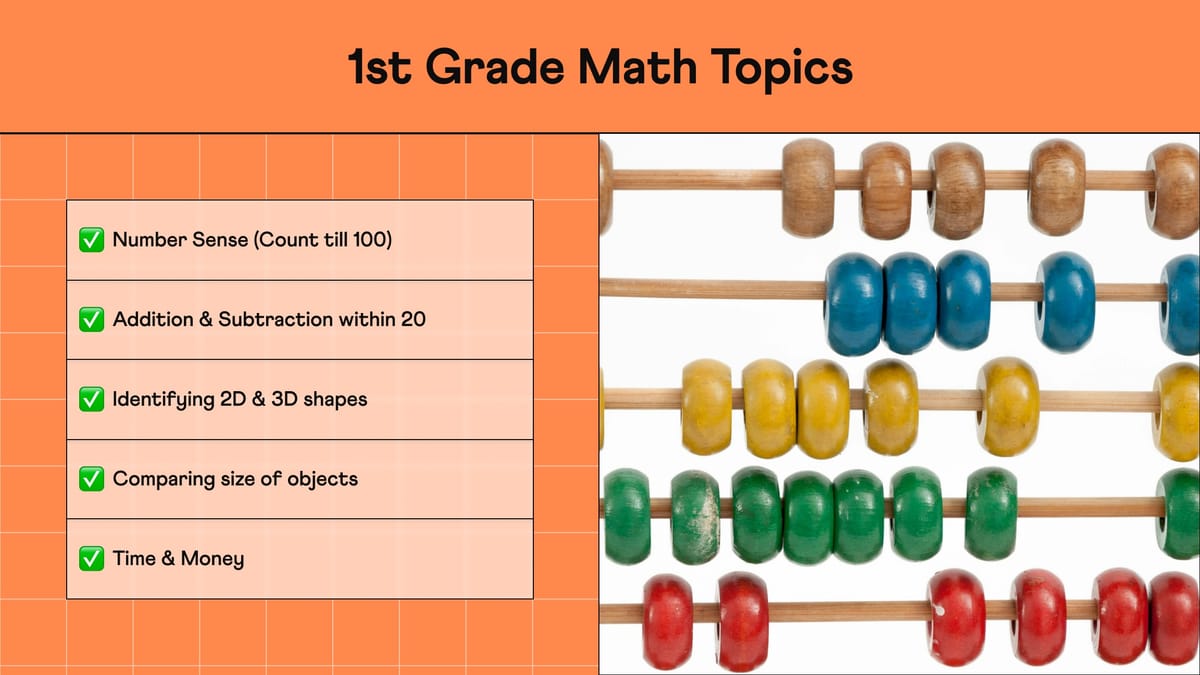
In 1st grade, students learn number sense, basic addition and subtraction, shapes and geometry, measurement, and telling time—with an emphasis on understanding how math works, not memorizing procedures.
So in this blog, I discuss core 1st-grade math topics that build the foundation for elementary and middle school. I will also share some teaching methods that our Cuemath tutors use to make sure children not only learn math concepts in 1st grade, but they can also apply them in real life.
Key Takeaways
- 1st graders build number sense, learning to count to 100, read/write numbers, and compare values.
- They learn basic addition and subtraction within 20, focusing on understanding—not speed.
- Geometry includes identifying 2D and 3D shapes and combining simple shapes.
- Measurement skills include comparing lengths and weights using everyday language.
- Students learn to tell time to the hour and half-hour on an analog clock.
- The focus is on conceptual understanding, not worksheets or memorization.
1. Counting & Number Sense (Up to 100)
According to the Missouri Education Study, if children understand skip-counting in 1st grade, they can easily learn division and tables in Grade 3 and above.
Common challenges:
- Kids know how to count, but make mistakes when numbers aren’t in order.
- A Cuemath parent shared that their child had previously memorized how to count, but became confused in real-world use (counting objects and solving puzzles).
Expert-Backed, Fun Ways to Build Number Sense
Here’s what works, according to math education experts and Cuemath Math Tutors:
- Post a hundred chart where your child sees it daily (fridge/bedroom door). Every morning, point to today’s date and ask: “What comes one before today? What will tomorrow be?”
- Ask, “What comes before 36? After 89?” in random real-life moments (car rides, shopping).
- On a napkin, write: “18, __, 20” - challenge your child to fill in the blank, then switch roles.
2. Addition & Subtraction Within 20
Children are expected to learn the math behind and solve simple sums mentally like 13 + 5 or 17 – 8, not just on worksheets, but in real-life contexts.
Common Challenges:
Relying on counting fingers or tally marks slows progress as numbers get larger.
A tutor on Reddit shared: “I see kids in Grade 3 still counting up on their fingers for 8 + 7—they get stuck on time tests and lose confidence fast.”
Similarly, a parent on Reddit shared: “My child could add with blocks, but froze on word problems during tests.”
Expert-Backed, Real-Life Ways to Teach:
- Questions related to snacks or play, build mental math, and make 1st grade math feel meaningful, like “We have 15 crackers and you ate 8. How many left?”
- Use two dice or playing cards to “build 10.” E.g., turn over a 7—ask, “What do you need to make 10?”
- Ask your child, “How did you find 9 + 6?” Kids who explain their thinking develop problem-solving skills faster.
3. Understanding Place Value
1st grade students must recognize that numbers like 42 mean “4 tens and 2 ones”. Place value knowledge in Grade 1 is the single best predictor of success in adding/subtracting multi-digit numbers, regrouping (‘carrying/borrowing’), and even multiplication in later grades.
Common breakdowns:
- Kids read numbers but don’t know what the digits really mean.
- They count by ones instead of seeing and grouping by tens. This becomes a habit that creates trouble with later regrouping and mental math.
Expert-Backed, Practical Ways to Teach Place Value:
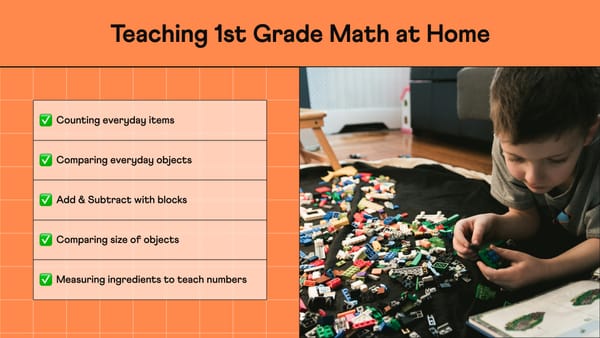
- Take 34 small items (beans, coins, LEGO bricks). Ask: “Can we make any groups of ten? How many tens? How many ones left?”
- Pick a number (e.g., 36). Ask: “Can you show me 36 as 3 tens and 6 ones? As 20 + 16? As two 15s plus 6?”
4. Patterns, Sorting & Categorization
Kids practice grouping objects by size, color, shape, or even more than one attribute at a time. Pattern recognition from 1st grade predicts algebra success, plus foundational logic for science, coding, and real-life sorting.
Source: John Hopkins StudyCommon Challenges:
One parent on Trustpilot shared, “My son could recite the sock pattern we made, but if I switched the objects to cars or blocks, he got lost.”
Kids over-rely on memorizing one pattern (ABAB) and struggle to generalize. When sorting by more than one feature (size and color), children may freeze or mix up groups.
Expert-Backed, Practical Ways to Teach Patterns & Sorting:
Research shows that building patterns with everyday objects builds concepts far better than drawings on paper. Challenge children during chores: “Let’s line up your cars—red, blue, red, blue. What’s next?”
5. Geometry: 2D & 3D Shapes
Children classify shapes based on their features and compare similarities and differences. They learn to talk about shapes using terms like corners, edges, faces, and curves.
Common Challenges:
- Kids often memorize names but don’t connect them to real-life objects.
- Parents may focus only on 2D shapes, leaving 3D shapes (like cubes, cylinders) under-explored.
Expert-Recommended Ways to Teach Geometry:
- Challenge your child: “Let’s spot 5 rectangles and 3 cylinders at home/in the park.” Extend the question: “What’s different between this rectangle and your square sticker?
- Notice and talk about shapes in the world around you—geometry is everywhere.
6. Measurement & Data
When students learn math in 1st grade, they also study the basics of measurement and data.
- Measure length, weight, and capacity: Using non-standard (paper clips, hands) and standard (ruler, cup) units.
- Compare and estimate: “Which is longer? Which holds more?”
- Collect and show data: Tally marks, picture/bar graphs, simple surveys
Where Kids and Parents Struggle:
A popular question on Quora talked about how a child could use a ruler but didn’t understand why a cup filled more than another. Kids confuse height vs. length, or forget to start at zero on a ruler.
Research-Backed Ways to Teach:
- Let your child measure ingredients (cups, spoons) or guess which container holds more.
- Track family shoe sizes or snack counts—draw a simple bar graph together.
- Use pouring, stacking, and comparing to make measurements “make sense.”
7. Time & Money
Understanding time and money builds life skills and involves applying multiple math concepts at once (number sense, counting, place value). But telling time in “half-past” or “quarter to” terms is trickier without an analog clock at home.
Here’s what you can do:
- Ask every morning: “What time is it? When is lunch?”
- Point out: “It’s 7:30—where are the big and little hands?”
- Give a handful of coins to “shop”—ask your child to pay exact amounts (e.g., “Can you make 75 cents with coins?”).
8. Introduction to Fractions
Here’s what’s taught in 1st grade:
- Understanding equal parts: Divide objects into halves, thirds, and fourths; learn that fractions mean “fair shares.”
- Naming and comparing fractions: Recognize basic fraction notation and compare simple parts
Why do students find fractions difficult?
- Kids recite fraction words but don’t see what “equal parts” means in real life.
- 1st grade math worksheets alone don’t make fractions visual or meaningful.
Expert-Approved, Practical Fraction Teaching:
- Ask, “If we eat 2 out of 4 pieces, what part is left?” Tweak the language and logic.
- Use store-bought or homemade puzzles to build and match different fractional parts.
- Divide toys or treats among friends, discuss: “Do we all get fair shares? Why or why not?”
Mathematical Thinking Starts in 1st Grade: How to Build it With Cuemath?
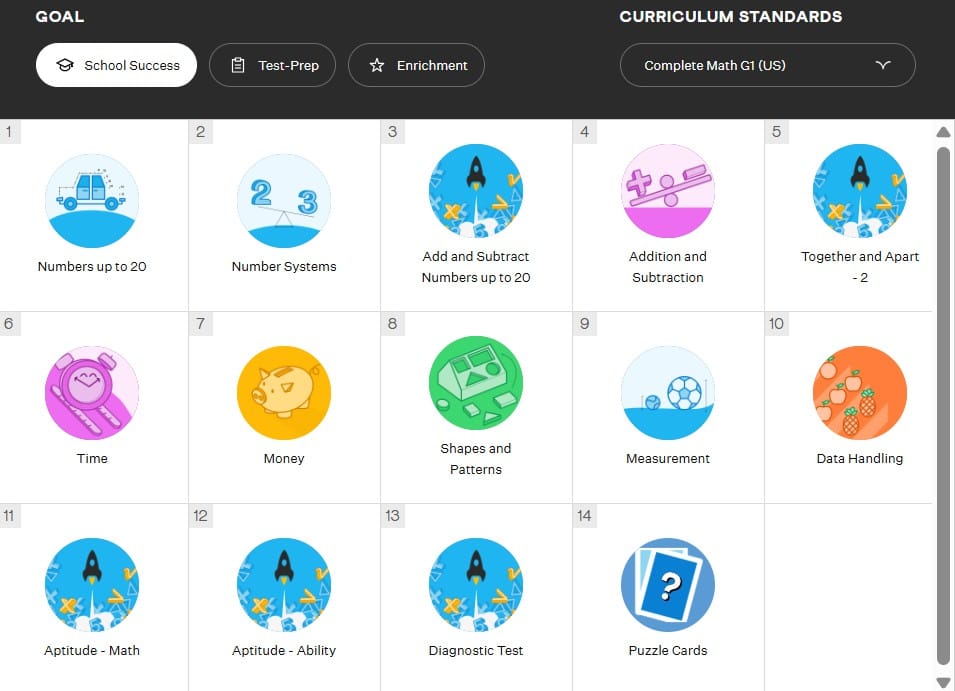
At Cuemath, we understand exactly how 1st graders think and learn math. Our online math courses aren't about rushing through concepts or memorizing formulas; it's about building real-world mathematical understanding.
What makes us different:
- We follow the Concrete-Pictorial-Abstract progression religiously, never skipping steps.
- Our tutors are trained in child psychology, not just math; they know where 1st graders typically struggle and how to address it.
- We build what we call Mathematical Fitness—the skills that transfer to every subject and every challenge your child will face.
The result? Children who don't just solve math problems, they approach challenges with confidence, break down complex ideas logically, and develop the mental agility that serves them throughout their lives.
Want your child to feel confident in math?
Join 400,000+ families who trust Cuemath for expert 1:1 tutoring and real-life math learning. Try a FREE live Cuemath class today.
Book a Free ClassFor Students in Grades K to 12 Worldwide
Frequently Asked Questions (FAQs)
How do I help my 1st grader with math at home?
Use hands-on activities (blocks, daily games, sorting, measuring) to build confidence—don't just do worksheets.
How to teach math to a 1st grader?
The best way to teach math to a 1st grader is to keep it hands-on, visual, and fun. At this age, kids learn best when they can touch, see, and play with numbers.
- Use objects around the house, like blocks, coins, or snacks, to help them add, subtract, or understand place value.
- Start with real-world problems like: “You had 5 strawberries and ate 2. How many are left?”
- Support their thinking with tools like number lines and ten frames, and don’t worry about speed; instead, focus on helping them explain their thinking.
- Look for activities that build number sense, addition/subtraction strategies, and early place value understanding. These are the building blocks of grade 1 math.
What are the core topics in 1st grade math curriculum?
In 1st grade, children learn the basics of addition and subtraction up to 20. The 1st grade math curriculum also includes fundamental topics such as place value, skip counting, telling time, and counting basic money.
How to teach Common Core math in 1st grade?
Teaching Common Core math in grade 1 focuses on conceptual understanding and problem-solving. Use hands-on tools like number lines, ten-frames, and visual models. Encourage students to try different approaches to solve problems and ask them to explain their thought processes. Real-world examples and consistent practice help build a strong foundation.
What are some popular ‘would you rather’ questions for 1st grade?
Here are some popular ‘Would You Rather’ questions for 1st grade math. These questions help to engage kids in simple math problems naturally:
- Would you rather have 5 apples or 3 apples and 2 more?
- Would you rather add 4 + 3 or 2 + 5?
- Would you rather count to 20 by ones or by twos?
- Would you rather have 10 candies and eat 3 or have 8 candies and eat 1?
- Would you rather group toys in sets of 2 or sets of 5?
These questions help students understand basic addition, subtraction, counting, and grouping concepts appropriate for 1st graders.
Are 1st graders introduced to math word problems?
Yes, 1st graders are introduced to simple math word problems involving addition, subtraction, time, and measurement. While their reading abilities are still developing, students often solve problems with support, using drawings, manipulatives, and guided group practice to build understanding and confidence.
What are some math terms 1st graders should know?
Common math terms for 1st graders include:
- Add, addition, sum
- Subtract, subtraction, difference
- Number line, number sentence
- More, less, equal, total, part, whole
- Shapes (circle, triangle, square, rectangle, cube, cylinder)
- Measure, length, data, bar graph, tally mark
- Time, clock, hour, minute
- Money, cent, value
Does Cuemath offer 1st grade math worksheets?
At Cuemath, we offer free 1st grade math worksheets and assessments as a key part of our study plans. Our 1st grade math worksheets include puzzles, colorful pictures, and interactive activities to spark curiosity. Each worksheet is carefully designed to reinforce core math concepts, encourage problem-solving, and make practice fun, not boring.