SAT vs ACT Math: Which Test Fits Your Strengths?
Every high school student or college applicant has asked this question a lot online: Do universities prefer SAT over ACT? The short answer is no. But the long answer? While colleges might not have a preference, you definitely should.

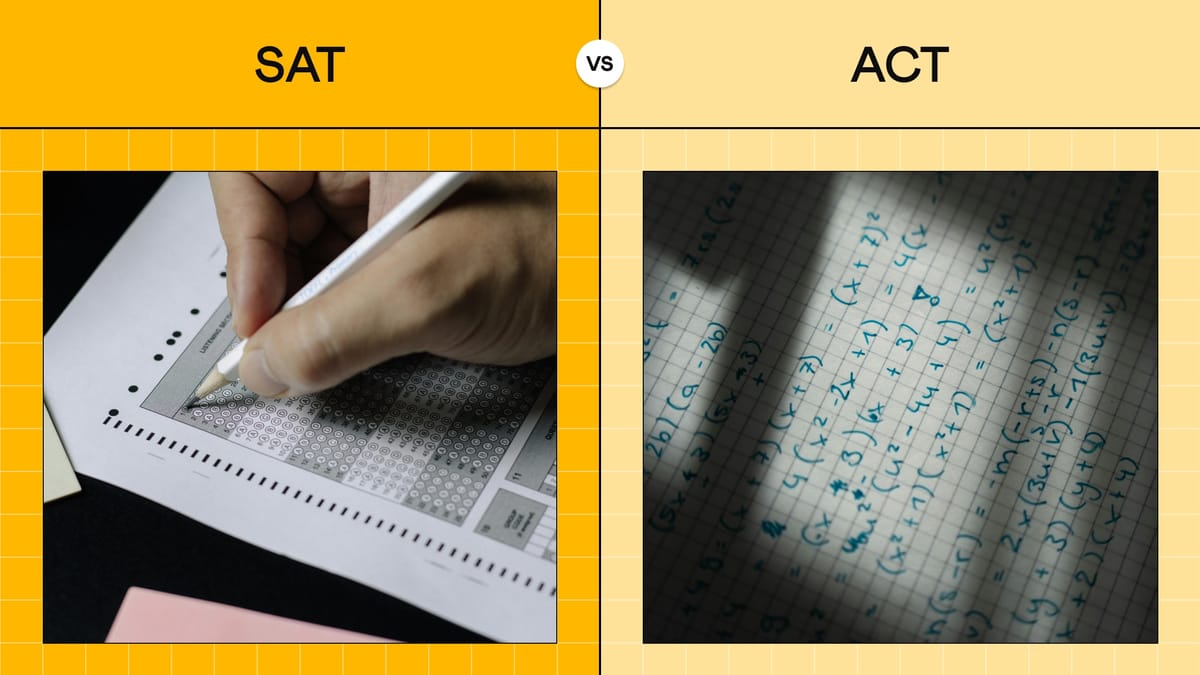
For a high school student preparing and applying to their dream colleges, the choice between the SAT and ACT isn't just about fulfilling the admission requirements; it’s about strategy.
I’ve analyzed the mechanics of the new Digital SAT and the Enhanced ACT, and the data is clear: choosing the test that aligns with your cognitive strengths (are you a quick problem-solver or a logical thinker?) can be the deciding factor in your acceptance letter.
Here is how to decide which test better fits your strengths and gives you the competitive edge.
Key Takeaways
- College preference: Universities do not favor the SAT over the ACT, or vice versa.
- The Difference: SAT focuses more on reasoning and problem-solving, while the ACT emphasizes speed and recall.
- Time per question: The SAT offers ~95 seconds per math question, while the ACT offers ~67 seconds.
- Choose the SAT: If you excel at Algebra and logical thinking.
- Choose the ACT: If you are strong in Geometry and spatial reasoning.
- Tech advantage: The Digital SAT includes a built-in Desmos calculator for visual solving.
- Major alignment: Pre-Med students often benefit from the ACT Science section; Humanities students often prefer the SAT.
- Formula rules: The ACT requires you to memorize formulas; the SAT provides a reference sheet.
- Final step: Take one official practice test of each to compare your scores.
Can Students Choose Between SAT and ACT?
Every high school student or college applicant has asked this question a lot online: "Do universities prefer SAT over ACT?"
The short answer is no. But the long answer? While colleges might not have a preference, you definitely should.
I have looked into the admissions policies of major universities, from the Ivy League to Stanford and MIT, and here is the reality: they view the SAT and ACT as interchangeable credentials.

- The Logic Behind It: Admissions officers use something called concordance tables to equate the scores. For example, they view a 34 on the ACT as roughly equivalent to a 1500 on the SAT.
- Some states (like Illinois, Colorado, and Tennessee) mandate a specific test for high school graduation.
What Are These Tests Actually Looking For?
To really make a decision, you have to understand the personalities of the SAT and ACT math tests.
- SAT Reflects Thinking and Fluidity I view the SAT as a test that challenges you to deep-dive into concepts. It’s less about how many formulas you have memorized. Can you solve a problem creatively? Can you use the Desmos calculator to solve an equation? It is built to reward the deliberate thinker.
- ACT Math Reflects Speed and Memory: In contrast, the ACT is a test of pure speed. It rewards the fast processor who can spot a standard problem type and execute the steps immediately without hesitation.
SAT vs ACT: What Top Colleges Expect?
When you are aiming for those dream colleges, I’ve found that the definition of a good score shifts quite a bit depending on what you plan to study.
If you are applying for Engineering or Computer Science, the reality is that the bar is simply higher. From what I've seen in the data, STEM applicants are held to a much stricter standard on the math section compared to Humanities applicants.
To help you visualize this, I aggregated the admissions data in the table below.
SAT vs ACT: Which Test Fits Your Major?
Here is something many students overlook: your intended major (STEM, arts, humanities, etc.) should actually play a huge role in which test you choose.
Why? Colleges are looking for specific cognitive strengths depending on your path. The skills they value for a Pre-Med applicant are often quite different from what they look for in an Engineering or English major.
The Digital SAT: Adaptive Format & The Desmos Advantage
Since going digital in 2024, I’ve seen the SAT evolve into a test of algebraic fluency and technological ease.
- Adaptive Format: It’s split into two modules; your performance on the first half determines how hard the second half gets.
- More Breathing Room: You get about 95 seconds per question, which is perfect if you hate feeling rushed.
- The Shock: Be ready for Module 2, where the questions often spike in difficulty and become much more abstract.
- The Desmos Advantage: The built-in calculator is a game-changer. Many students on Reddit have shared how they use it like a cheat code to solve complex algebra problems.
The Enhanced ACT: The Sprinter's Test
Starting Spring 2025, the updated ACT is of a shorter format, but I’ve found the core challenge remains the same: speed.
- The section is now 45 questions in 50 minutes.
- You have roughly 67 seconds per question. Unlike the SAT, you can’t afford to get stuck; you need to recognize the solution path instantly.
- While now optional, I strongly recommend submitting a Science score if you are applying for a STEM major.
- Geometry and Trigonometry make up 35-40% of the score, and there is no reference sheet—you must memorize your formulas.
- It covers a wider range of topics than the SAT (like matrices and logs), but the questions usually stick to the basics.
Student Voices: The Real Debate Between SAT and ACT
To get a reality check, I dived into student discussions on Reddit (r/SAT and r/ACT) to see how these exams actually feel in the moment. Here is what I found:
- I noticed that Humanities students prefer the SAT Math over ACT Math. Why? Because the questions are basically reading comprehension puzzles wrapped in algebra. If you have strong verbal skills, you can often logic your way to the answer.
- If you need to feel in control, the SAT can be tough. The sudden difficulty spike in Module 2 often triggers a panic spiral for students who aren't used to seeing questions they can't immediately answer.
- If you hate being rushed, the ACT is a nightmare. They prefer the SAT simply because 95 seconds per question finally gives them enough room to breathe.
Conclusion: How to Choose Between SAT and ACT?
- Choose the ACT if you enjoy math in general. If you have your geometry formulas memorized, you work fast, and you want to showcase your science literacy for a path like Pre-Med or Engineering, this is your lane.
- Choose the SAT if you are an expert in Algebra. If you prefer having time to think deeply rather than racing the clock, and you love using digital tools like Desmos to solve problems, this is the better fit.
My Key Takeaway: Don't just guess. Download the Bluebook app for the SAT and grab an official ACT practice PDF. Spend a weekend taking one of each. Trust me, your score, and more importantly, your comfort level during those three hours will tell you exactly which path to take.
1:1 Tutoring + Tailored Test Prep Plan
Get a test prep plan with free practice workshets with the regular Cuemath plan. Try a FREE live Cuemath class today.
Book a Free ClassFor Students in Grades K to 12 Worldwide
Frequently Asked Questions (FAQs)
Ques: What’s the main difference between the SAT and ACT?
Ans: The SAT and ACT are both college entrance exams used in the U.S., and colleges accept either one equally. The ACT’s Science section tests interpretation and analysis more than specific science facts, and it generally has more questions with less time per question.
The SAT gives you slightly more time per question and integrates science reasoning into reading and math rather than through a separate science section.
Ques: Is the SAT easier than the ACT?
Ans: Many students online say the ACT feels easier because its questions are more straightforward, but the pacing is faster, and the time pressure is higher. Others say the SAT feels easier because you have more time per question and there’s no separate science section.
In general, the difficulty is subjective, and your performance will depend on your reading speed, test-taking strategy, and what kinds of questions you find easier.
Ques: Should I take the SAT or the ACT?
Ans: To decide, many students try practice tests for both and see where their skills fit better. If you understand grammar and punctuation well, like doing quicker questions, and don’t mind science passages, the ACT might suit you.
If you prefer more time per question and math that focuses on reasoning rather than speed, you might like the SAT better.
Ques: Do colleges prefer the SAT over the ACT?
Ans: No, colleges accept SAT and ACT scores equally and don’t favor one on applications. For example, in some states students take the ACT as a school test, so more scores from those areas are ACT scores, but that doesn’t mean colleges prefer them. What matters most is your highest score and how you present your whole application.
Ques: Which test is better for scholarships or college?
Ans: Scholarships and colleges generally accept either exam’s score. Some scholarship programs publish score ranges for eligibility on both tests, and you can convert ACT to SAT scores with official concordance tables if needed. Taking practice exams and comparing your results is a useful way to see which might help you personally get stronger scores.