Math Kangaroo Past Papers: What's Free and How to Use Them
You do not need to buy anything to see what Math Kangaroo looks like. What the organizer gives away free at every level, and a plain way to use one past paper properly.

You do not need to buy anything to find out what Math Kangaroo looks like. The organizer posts free sample papers for every level, gives away a few full past exams, and publishes every answer key back to 1998. What costs money is the convenience around that core: more years of exams in online form and written solutions. This page maps what is free, what the test looks like at each level, and a plain way to use a past paper once you have one.
Where the past papers live
Everything below sits on mathkangaroo.org, the organizer's own site.
Start with the free sample questions page. It carries one downloadable sample PDF per year, from 2006 through 2026, and the newest set has a section per grade band. Open it, turn to your child's band, and you can see real question styles in about a minute.
For full past exams, the site has one practice page per grade band: grades 1-2, grades 3-4, and so on up to grades 11-12. We checked all six in September 2026, and the same four years are marked free on every one: the 2010 and 2020 exams as online versions you can take more than once, and the 2015 and 2025 papers as printable PDFs. The other years go through the organizer's store. The online section also offers exams sorted by difficulty, not just by year. And how far back the shelf runs depends on the band: the printable papers reach back to 1998 on every band except grades 1-2, where they start at 2005.
Answer keys are free for every year from 1998 through 2026, one key per year. Written solutions are where the store comes in: each band page lists expert-written solution PDFs with no free years marked, and the samples page sends you to the organizer's store for more questions and solutions from previous years.
What the test looks like at each level
The organizer runs 12 grade levels. Every level uses one of two formats:
| Grades | Questions | Time | Maximum score |
|---|---|---|---|
| 1-4 | 24 | 75 minutes | 96 |
| 5-12 | 30 | 75 minutes | 120 |
From mathkangaroo.org's own test pages, checked September 2026.
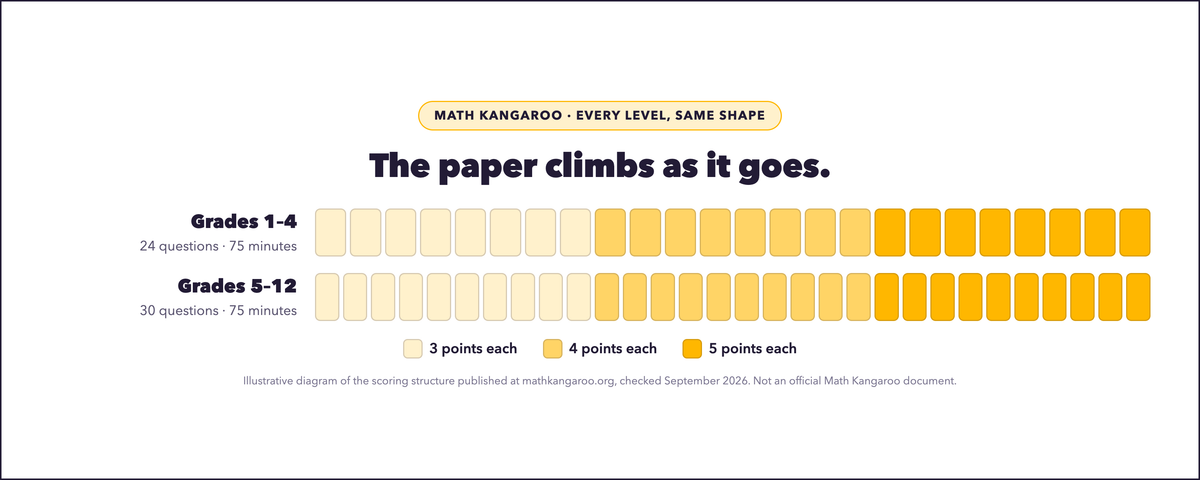
Every paper is multiple choice, and the scoring shape is the same throughout: a third of the questions are worth 3 points each, a third 4 points, and a third 5 points. The paper climbs as it goes. At grades 1-4, questions 1-8 are the 3-point questions, 9-16 the 4-point ones, and 17-24 the 5-point ones. At grades 5-12 the blocks are 1-10, 11-20, and 21-30.
No points are taken away for a wrong answer. That one rule should shape how your child takes the paper: an unanswered question and a wrong answer cost the same, so nothing should be left blank.
The clock is the other thing a past paper teaches. All levels get 75 minutes, but grades 1-4 face 24 questions, about three minutes each, while grades 5-12 face 30, which is two and a half minutes each. A child who has only seen school tests has usually never worked against that budget.
A plain way to use one
A past paper is a rehearsal, not a worksheet. The structure above suggests a simple sequence:
- Open the newest free sample PDF and turn to your child's grade band first. Ten minutes of looking tells both of you what the question style is, before any clock starts.
- Give one full paper the real 75 minutes, with no help. The free 2015 or 2025 PDF is the natural first pick, and the printable version matches test-day conditions better than the online one.
- Score it with the free answer key for that year, using the point weights. The total matters less than where the points went.
- Read the shape of the result. Points lost in the first block usually come from rushing, since those are the 3-point questions a child at that level is expected to get. Points lost in the last block come from the hardest questions, and losing some of them is normal. And questions never reached are a time problem, not an ability problem; running out of clock needs a different fix than finding questions hard.
- Repeat with a second paper only after talking through the first. If your child needs to see why an answer is what it is and the two of you cannot work out the reasoning together, that is what the solution PDFs in the organizer's store are for. Buy explanations, not more papers.
The organizer's own FAQ says the competition runs once a year, on the third Thursday of March, and its homepage currently says March 2027 without naming the date. So a family starting now has about six months, which is comfortably enough for a paper a month. Registration is a separate question with its own dates, and it is not this page's job; the organizer's registration page carries the current dates.
If you are weighing school-year competitions more broadly, the AMC 8 and MOEMS run on a different model, where a school or a team enters the child, rather than the parent registering directly.
Where Cuemath fits
We do not run Math Kangaroo, and a past paper from the organizer is the single most honest picture of the test you can get. Nothing replaces it.
What a past paper shows you is how your child handles a problem they have not seen before, against the clock. If the first scored paper leaves you unsure what the result means, that question is bigger than one competition, and it is the exact question a Cuemath evaluation spends an hour on. What happens in that hour, and what you walk away with, is written up in what a MathFit evaluation actually is.
Want to know what your child's paper is telling you?
One hour, unfamiliar problems, and a clear read on how your child reasons.
Book a Free EvaluationFor students in Grades K to 12 worldwide.
FAQs
When do Math Kangaroo results come out?
Results are expected on or before May 1, in the account used during registration. The answer key comes sooner: Math Kangaroo says it publishes it one month after the first day of the competition. Scoring a past paper at home is faster still: every year's key back to 1998 is already posted.
Do a second grader and a sixth grader take different papers?
Yes. The organizer offers 12 grade levels and pairs them in its practice material: Levels 1 and 2 up through Levels 11 and 12. The paper grows at grade 5: grades 1-4 answer 24 questions, grades 5 and up answer 30, in the same 75 minutes. A kindergartner is welcome too; the organizer's FAQ says kindergarten students participate at grade 1.
What is the difference between the sample sets and the past papers?
The sample sets are free previews: one PDF per year from 2006 through 2026, with a section for each grade band inside. The full past exams live on each band's own practice page, in online and printable forms, with a few years free and the rest in the store. The samples are the faster first look; a full paper against the clock is the real rehearsal.
Are there solutions, or just answer keys?
Both, but only the keys are free. The answer key is one file per year, back to 1998, with all six grade bands in one table; we opened the 2026 key to check. Written step-by-step solutions are listed on each band's practice page and in the organizer's store, and the site also lists video solutions among its practice material.
How many past papers should my child do?
The organizer's pages do not say, and we did not find a number worth trusting anywhere else. Our suggestion is pace, not volume: one full paper under the real 75 minutes, talked through before the next one starts. A child who has done three papers that way is better rehearsed than one who has rushed through ten.