How to Teach 1st Grade Math at Home: A Practical Guide for Parents
After speaking with dozens of Cuemath tutors who teach K–2 students every day, one insight comes up again and again: parents also want to help students learn math at home, but they are unsure where to focus or how to support learning without turning home into another classroom.

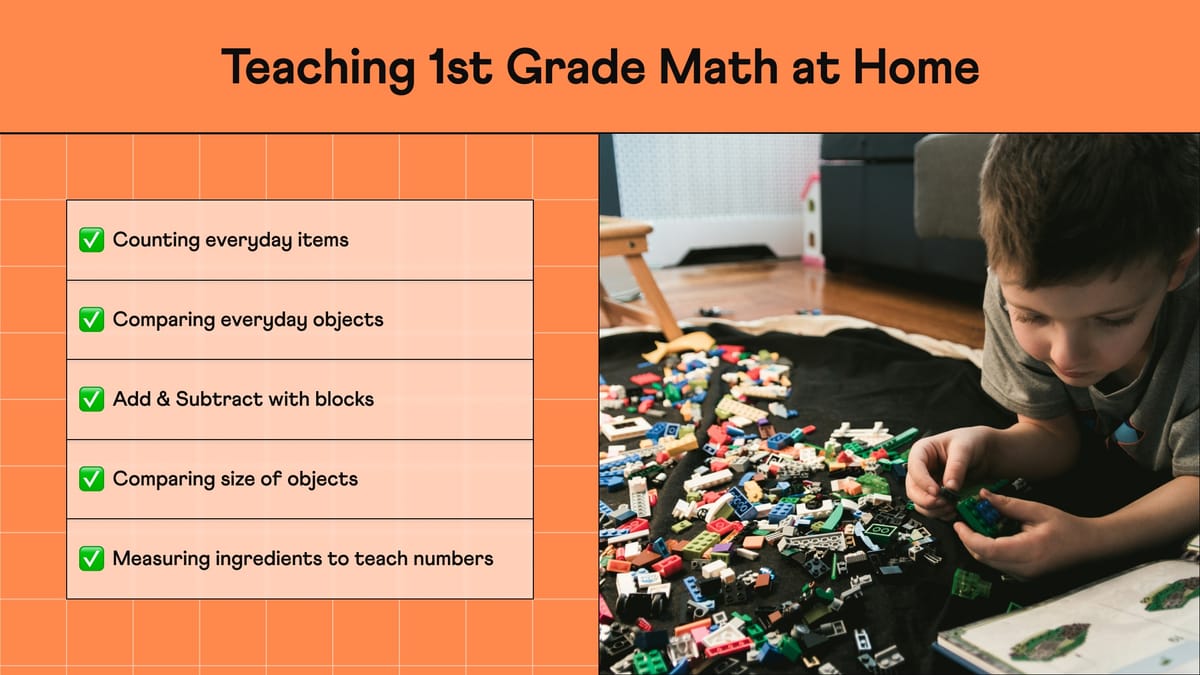
The best way to teach 1st-grade math at home is to focus on core concepts, use everyday activities like cooking and play, and pair simple home practice with expert guidance to build confidence and understanding.
You know 1st-grade math is foundational. You want your child to feel confident with numbers, not anxious or dependent on memorization. In this blog, I discuss two things that work best:
- Clear expectations of what 1st graders actually need to know
- Simple, real-world math strategies that Cuemath tutors regularly recommend to parents
Key Takeaways
- Focus on understanding, not just getting the right answers: 1st-grade math is about building strong foundations, not memorization.
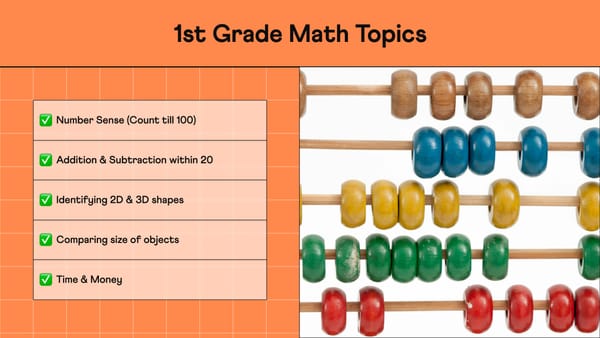
- Prioritize four core areas: number sense, addition & subtraction, shapes & geometry, and measurement & time.
- Use real-life activities (kitchen, play, stories) to make math meaningful and stress-free.
- Ask children to explain their thinking — confidence grows when they understand the “why.”
- The best results come from both expert tutoring and simple at-home practice working together.
What Math Should a 1st Grader Know? A Curriculum Checklist
Cuemath tutors consistently remind parents that the 1st-grade math curriculum isn’t about speed or worksheets — it’s about building understanding that lasts. When this foundation is strong, children progress faster and with far less frustration later on.
Here are the four core areas tutors focus on most.
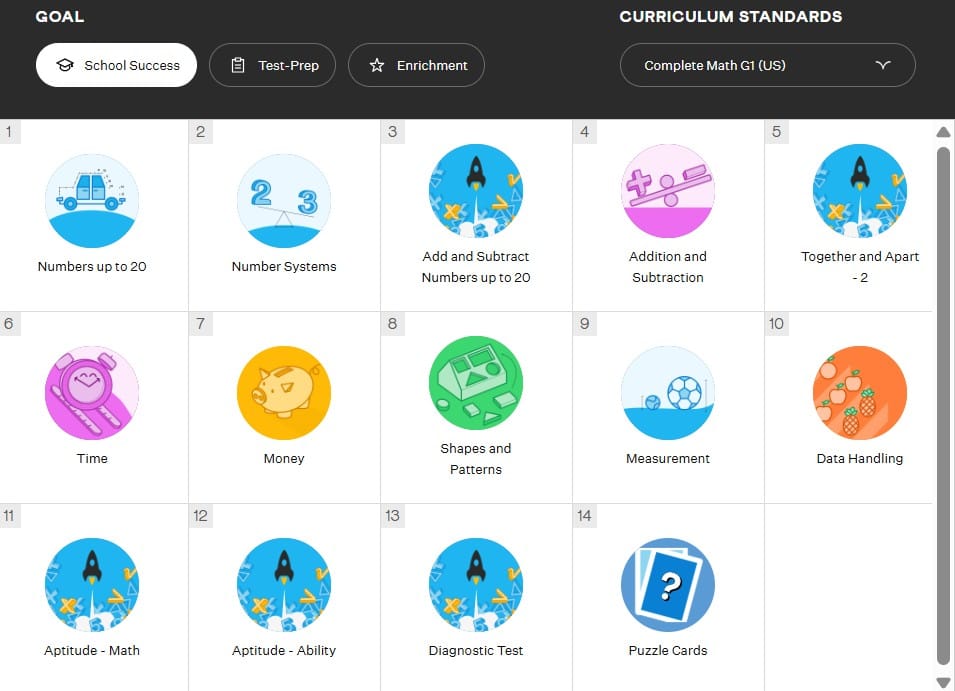
Building Number Sense
This is the intuition for what numbers mean.
- Can they count to 100 by ones and tens?
- Can they read and write numbers up to 20?
- Do they understand concepts like "more than," "less than," and "equal to"?
- Can they count objects accurately (one-to-one correspondence)?
Mastering Basic Addition & Subtraction
This is where they move from counting to calculating.
- Can they solve simple addition and subtraction problems within 20? (e.g., 8+5, 15−6)
- Do they understand the meaning of the plus (+), minus (-), and equals (=) signs?
- Can they solve simple word problems by drawing pictures or using objects?
Exploring Shapes & Geometry
This is about understanding the space around them.
- Can they identify and describe 2D shapes (circles, squares, triangles, rectangles) and 3D shapes (cubes, spheres, cones)?
- Can they combine shapes to make new shapes? (e.g., two squares make a rectangle).
Understanding Measurement & Time
This applies math to the real world.
- Can they compare the length or weight of two objects using words like "longer," "shorter," or "heavier"?
- Can they tell time to the nearest hour and half-hour on a clock?
Simple 1st Grade Math Activities You Can Do Today
One thing I emphasize strongly: Good math practice doesn’t need special materials or extra time.
In fact, Cuemath tutors regularly share simple home strategies with parents.
1. Kitchen Math (While Cooking or Snacking)
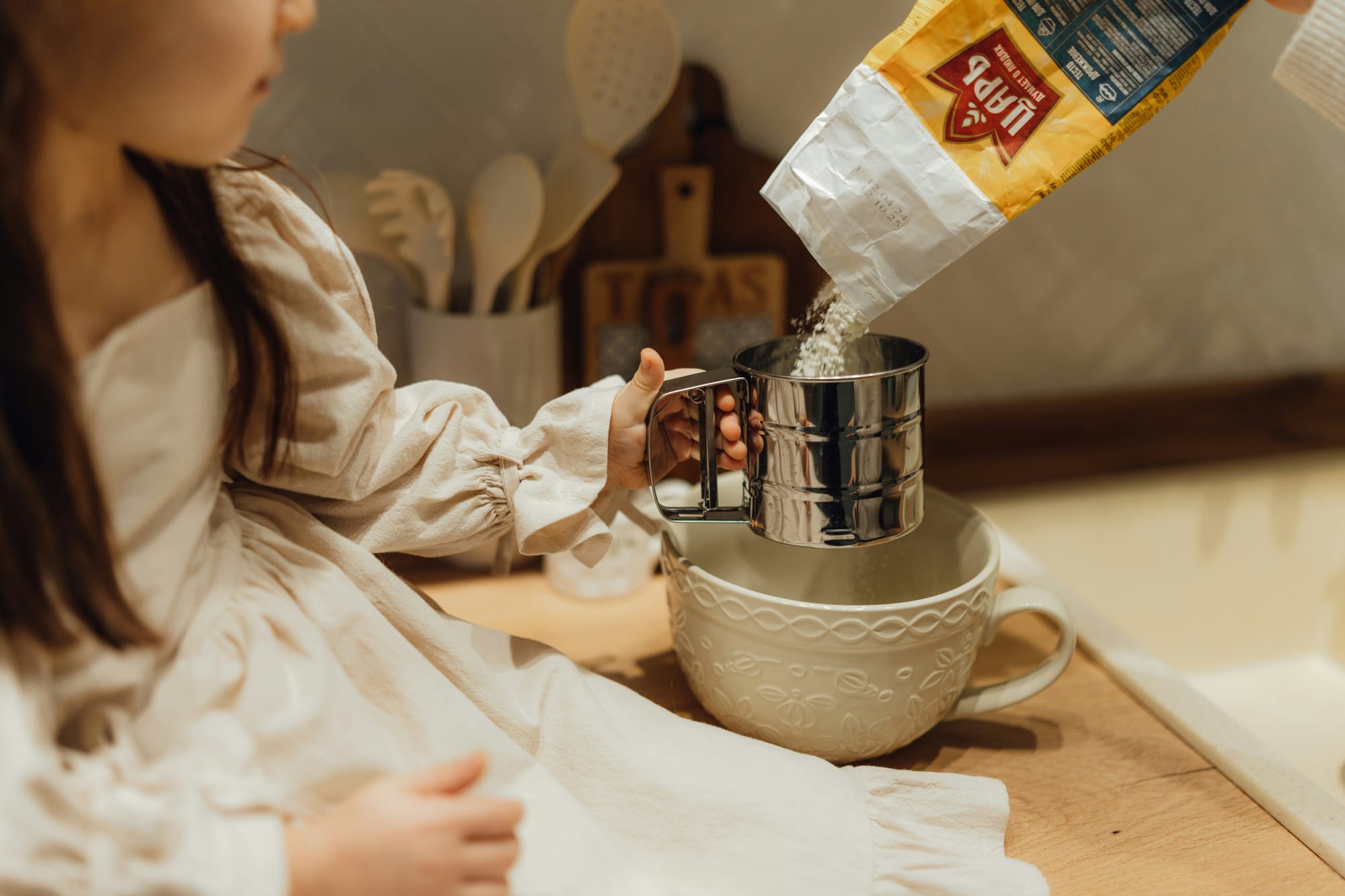
Your kitchen is a powerful math lab. Don't plan a lesson; just talk about what you're doing.
- The Activity: Ask your child to count the number of chapatis needed for dinner (one for each person). While splitting an apple, count the slices. Ask, "If I give you 2 slices and keep 2, do we have an equal amount?"
- The Logic Behind: It builds one-to-one correspondence, addition, and early fraction concepts — without a worksheet in sight.
2. Playtime Math (With Toys They Already Have)
Let playtime lead the learning, because it is full of math.
- The Activity: While playing with building blocks, ask questions like, "Can you build a tower that is 10 blocks tall?" or "Your tower is taller than mine. How many more blocks did you use?" Board games with dice are also fantastic for teaching instant addition.
- The Logic Behind: Children learn comparison, addition, and spatial reasoning while staying engaged — no resistance, no pressure.
3. Story Time Math (During Bedtime Reading)
Turn passive reading into an interactive math moment.
- The Activity: Pick a book and ask your child to count the number of ducks on the page. Ask "what if" questions: "There are 3 friends in this story. What if 2 more friends joined them? How many would there be then?"
- The Logic Behind: It prepares children for word problems by making numbers feel meaningful and familiar.
Building a Confident 1st Grade Math Student, Together
Confidence grows when children learn math in multiple ways — through 1:1 classes and real-world application.
Life gets busy, and that’s part of parenting. The goal isn’t to teach perfectly every day—it’s to help your child feel confident and capable. Sometimes, that support comes from a math tutor who truly understands your child.
At Cuemath, we work alongside parents to build mathematical fitness, so children grow into confident and curious problem-solvers.
Daily games and puzzles you can play after Cuemath class
How Cuemath Supports the Best of Both Worlds?
- Expert tutor guidance: Cuemath tutors help children think logically, explain their reasoning, and approach challenges calmly.
- Everyday math strategies for parents: Parents gain ideas for simple games, conversations, and routines that reinforce learning naturally.
- Consistent, structured progress: While parents enjoy math moments at home, tutors ensure skills are developed in the right sequence — without gaps.
Want your child to feel confident in math?
Join 400,000+ families who trust Cuemath for expert 1:1 tutoring and real-life math learning. Try a FREE live Cuemath class today.
Book a Free ClassFor Students in Grades K to 12 Worldwide
Frequently Asked Questions (FAQs)
What are the most important math skills for a 1st grader?
The most crucial skills are number sense (understanding numbers up to 100), fluency with basic addition and subtraction within 20, and the ability to solve simple, real-world word problems.
How long should a 1st grader practice math each day?
Consistency is more important than duration. 15-20 minutes of focused, engaging practice per day is far more effective than one long, stressful session per week.
How can I help my 1st grader with math word problems?
Encourage them to visualize the problem. Have them draw pictures or use small objects (like beans or buttons) to act out the story. The goal is to turn the words into a concrete scenario they can see and manipulate.
My 1st grader says they hate math. What should I do?
Focus on changing the experience. Move away from worksheets and pressure. Play math-based board games, use the "Kitchen Math" or "Playtime Math" ideas above, and celebrate their effort and strategic thinking, not just getting the right answer. Keep it light, positive, and connected to their world.
What is "number sense" and why is it important in 1st grade?
Number sense is a child's intuitive understanding of numbers. It includes knowing their value, how to compare them (more than/less than), and how they relate to each other. It's the most critical foundation for all future math, as it allows children to calculate flexibly instead of just memorizing rules.
Should a 1st grader be memorizing multiplication tables?
No. First grade focuses on the building blocks of addition and subtraction. While they may learn to count by 2s, 5s, and 10s (a pre-multiplication skill), formal memorization of multiplication tables typically begins in 3rd grade.
How do I explain subtraction to a 1st grader?
Use tangible objects. Start with a small group of items (e.g., 8 raisins), then "take away" a few and ask how many are left. This visual, hands-on method makes the concept of "taking away" concrete before introducing the minus symbol.
What are some fun math games for a 1st grader?
Simple board games with dice (like Snakes and Ladders) are excellent for practicing counting and addition. Card games like "War" (where the higher number wins) or "Go Fish" (for number recognition) are also fun and effective.
How can I help my child if they are struggling with math?
First, stay positive and reduce any pressure. Go back to basics and use hands-on tools like blocks or beads to make concepts visual. Focus on one small skill at a time and celebrate their effort and small wins. If struggles persist, seeking expert guidance can provide a personalized plan to rebuild their confidence.
How does math help a 1st grader's brain development?
Learning math in 1st grade helps develop crucial neural pathways for problem-solving, logical reasoning, and systematic thinking. It teaches them to see patterns, make connections, and approach challenges methodically, which are skills that benefit all areas of brain development.