High School Math: Every Class, Level & Subject Explained
From Algebra 1 to Calculus — understand the full course sequence, all math levels in high school, what colleges expect, and exactly how to choose your path in high school.

📅 Updated March 2026
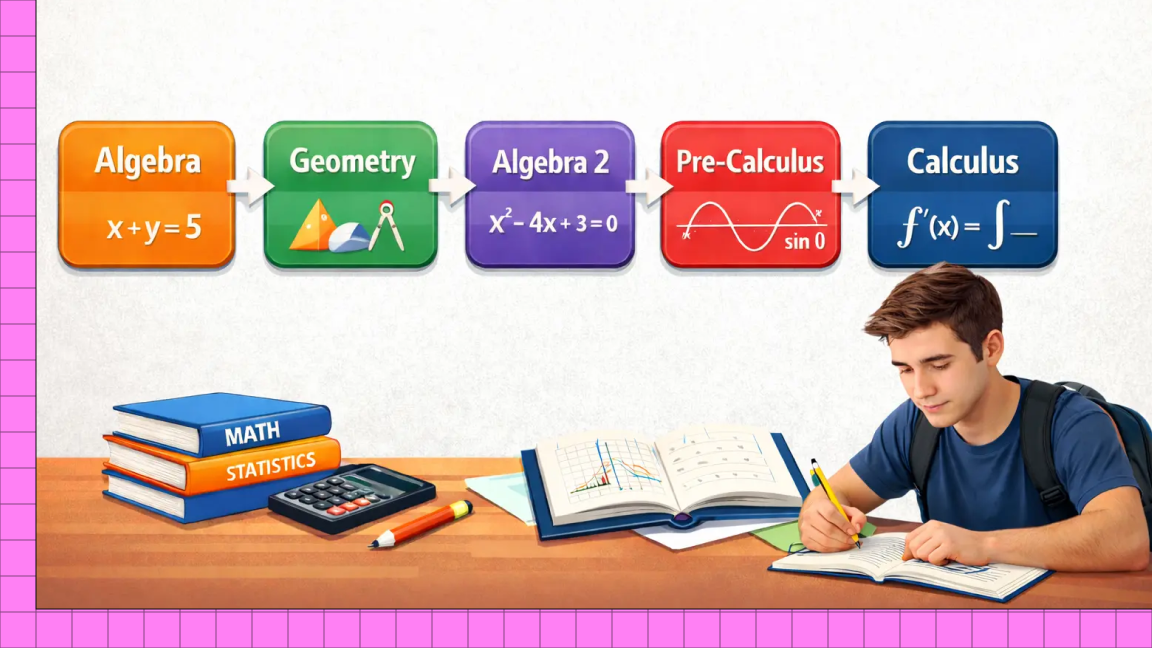
High school math classes follow a set sequence: Algebra 1, Geometry, Algebra 2, Pre-Calculus, and Calculus, but choosing the right path, level, and pace can feel overwhelming.
This guide walks through every high school math class and level, from standard courses to AP and IB, what colleges actually expect, and exactly how to plan your math path from 9th grade onward.
Whether you're a student, a parent, or just trying to make sense of high school math — everything you need is right here. No fluff. Just clarity.
Key Takeaways
TL; DR: Understanding High School Math Classes
-
Take four years of high school math.
Even if your state requires only three, most colleges expect four years of math classes in high school. Completing all high school math levels keeps college and career options open. -
Know the standard math course sequence.
The typical progression of math courses in high school is Algebra 1 → Geometry → Algebra 2 → Pre-Calculus → Calculus. Some schools rearrange these math subjects, and placement determines where students begin. -
STEM-bound students should aim for Calculus.
If you’re considering engineering, computer science, physics, or biology, reaching Calculus—often AP Calculus—by senior year is strongly recommended. These math topics form the foundation for most STEM majors. -
Honors and AP math are not the same.
Honors classes are advanced versions of standard math subjects and usually add a +0.5 GPA boost. AP math courses are college-level, include a national exam, and may earn college credit with a +1.0 GPA weight. -
Grades matter as much as course rigor.
Colleges evaluate both difficulty and performance. A strong grade in an Honors math course often looks better than a low grade in AP. Balance ambition with mastery across math levels in high school. -
Plan backward from your final goal.
Decide which math subject you want to finish with—such as Calculus or Statistics—then map the exact sequence of high school math classes needed to get there.

Table of Contents
- What Is High School Math? (And Why It Matters)
- The Standard Course Sequence — Year by Year (U.S.)
- Typical High School Math Classes by Grade (U.S.)
- All Math Courses in High School— Explained
- Math Levels in High School (Standard, Honors, AP, IB)
- Math Subjects in High School
- Topics in Mathematics Covered in High School
- The 6 Common Core Math Topics in High School
- State-by-State High School Math Requirements (U.S.)
- What Do Colleges Want From High School Math?
- How to Choose the Right High School Math Path
- What Math Class Should I Take? (Grade-by-Grade Guide)
- Dual Enrollment & Community College Math
- Top-Rated Learning Resources for High School Math (2026)
- Competitions & Extra Credit for College Readiness
- Frequently Asked Questions About High School Math
What Is High School Math? (And Why It Matters)
Quick Answer
- High school math is cumulative and typically requires 3–4 years minimum. Currently, 27 states require 3 years, while 17 states require 4 years.
- The standard sequence of math classes is Algebra 1 → Geometry → Algebra 2 → Pre-Calculus → Calculus. Each course builds on the previous one, so order matters.
- Most students take 3–4 years of high school math (3 required, 4 recommended by colleges). Students planning STEM majors should aim to reach Calculus by senior year.
High school math in the United States is a sequential, cumulative subject — each course builds directly on the one before it in a specific, non-negotiable order. Unlike subjects where you can jump around, math follows a specific order based on students' starting points and ability levels.
You can't skip steps in math the way you might with other subjects. If you struggle in Algebra 1, Geometry becomes harder. If Geometry is shaky, Algebra 2 suffers. This is why placement tests exist — schools use them to make sure every student starts exactly where they need to be.
Most high schools require students to complete at least 3 years of math to graduate. Students are typically assessed through the SAT Math, ACT Math, and state-specific tests like the PARCC or Smarter Balanced assessments, though 4 years is widely recommended because most colleges expect it.
Beyond academic requirements, high school math builds critical skills that transfer to every area of life: logical reasoning, problem-solving, analytical thinking, and the ability to work with data. These skills matter whether you're heading into engineering, business, healthcare, the arts, or any other field.
The Standard Course Sequence — Year by Year in High School (U.S.)
Quick Answer
- The standard sequence of high school math is Algebra 1 (9th) → Geometry (10th) → Algebra 2 (11th) → Pre-Calculus or Calculus (12th).
- Accelerated students who complete Algebra 1 in 8th grade can progress faster and may reach AP Calculus BC by senior year.
There is no single "official" order for high school math, but the vast majority of U.S. schools follow a very similar progression.
A typical U.S. high school math progression looks like this:
If you completed Algebra 1 in 8th grade — or even earlier — you can shift the entire sequence forward. This puts Calculus within reach by senior year.
Schools place students using placement tests, so strong middle school performance can automatically open doors to an accelerated track.
Keep in mind: Some schools teach Algebra 1 and Algebra 2 back-to-back before moving to Geometry. Others weave Trigonometry into Algebra 2 or Pre-Calculus instead of teaching it as its own class. The specific order depends on your school district, but the content covered across all these courses remains remarkably consistent nationwide.
What Are the Typical High School Math Classes by Grade (U.S.)
Most U.S. students follow this grade-by-grade progression, though placement tests and prior coursework can shift the timeline.
Here's a realistic, counsellor-approved math pathway in high school:
🎯 Key Points
- Your starting point depends on placement tests and middle school performance.
- Students who complete Algebra 1 in 8th grade are one year ahead and can reach Calculus by senior year.
- Data shows these students score an average of 75 points higher on the SAT Math section compared to peers on the standard track.
- Those starting with Algebra 1 in 9th grade typically end with Pre-Calculus unless they accelerate.
What Math Class Should I Take? (Grade-by-Grade U.S)
Not sure which math class is right for your grade? Here's practical advice for each year of high school.
9th Grade — What Math Should I Take as a Freshman?
Most 9th graders start with Algebra 1, and that's completely normal. If you already took Algebra 1 in 8th grade, you'll likely move straight into Geometry, which puts you a full year ahead. Don't stress about being on the "standard" track; starting strong in Algebra 1 and actually understanding it is far more valuable than rushing into a harder class and struggling. Your 9th-grade math sets the tone for everything that follows.
10th Grade — What Math Should I Take as a Sophomore?
If you're on the standard track, 10th grade is Geometry. If you're accelerated, it's Algebra 2. Geometry is often a surprise favorite — it's more visual and logical than Algebra, and many students who struggled in 9th grade find their footing here. This is also the year to start thinking about whether Honors is the right move for 11th grade. If you're finishing Geometry with A's, Honors Algebra 2 is worth considering.
11th Grade — What Math Should I Take as a Junior?
Junior year is where your math path starts to matter for college applications. Most students take Algebra 2 or Pre-Calculus in 11th grade. If you're STEM-bound, aim to finish Pre-Calculus this year so Calculus is available to you senior year. If STEM isn't your goal, a strong grade in Algebra 2 or Honors Algebra 2 is completely fine — and often smarter than taking Pre-Calc just for the label and earning a C.
12th Grade — What Math Should I Take as a Senior?
Senior year math depends entirely on what you've completed and where you're headed. STEM-focused students should be in AP Calculus AB, AP Calculus BC, or at a minimum Pre-Calculus. Non-STEM students who want an AP credit with real-world value should consider AP Statistics — it's genuinely useful in college regardless of major. The most important thing in senior year? Don't drop math entirely. Colleges notice a math gap in 12th grade, even if your state doesn't require it.
Accelerated Track — What If I'm Ahead?
If you finished Algebra 1 before high school, your sequence shifts forward by a year, and Calculus by senior year is very achievable. Some accelerated students even take AP Calculus BC in 11th grade and use 12th grade for college-level math through dual enrollment. If this is you, talk to your counselor early — planning the sequence from 8th grade onward makes a big difference in keeping doors open for competitive STEM programs.
All Math Courses in High School— Explained
Quick Answer
- The 6 core high school math classes (courses) are: Algebra 1 → Geometry → Algebra 2 → Trigonometry (often integrated) → Pre-Calculus → Calculus.
- Most students complete 3-4 of these courses depending on their pace, while AP Statistics and other electives are optional.
- Accelerated students may start Algebra 1 in 8th grade and progress to AP Calculus BC by senior year.
There are six core math courses in high school that nearly every U.S. student will encounter, plus several elective options.
The types of math classes in high school — and the range of math courses in high school available to students — span from foundational algebra to college-level calculus, and understanding each one before you enrol makes a massive difference.
Below is every math course, broken down by what it covers, when you'll take it, and why it matters.
Algebra 1
Typically 9th Grade · The Starting Point
Algebra 1 is the gateway to all high school math. Common textbooks include Larson’s Algebra 1, Big Ideas Math, and Glencoe Algebra 1.
This is where students shift from working with concrete numbers to working with variables and abstract expressions — a major mental leap. Students learn to solve, write, and graph equations, and begin seeing math as a language for describing real-world relationships.
Geometry
Typically 10th Grade · The Visual Thinker’s Class
Geometry is one of the oldest branches of mathematics and, interestingly, one of the most popular among students. This course focuses on shapes, space, and the relationships between them.
Geometry introduces formal proofs — a skill that builds logical and critical thinking in ways few other classes do. It also lays important groundwork for trigonometry.
Trigonometry
Usually Integrated · Not Always a Standalone Course
Trigonometry bridges algebra and geometry by studying the relationships between angles and sides of triangles — then extending those relationships to circular and periodic functions.
In most U.S. high schools, trigonometry isn’t a separate class. Instead, its content is woven into Algebra 2, Geometry, or Pre-Calculus. When it is offered as a standalone course, it’s typically for students on an accelerated track.
Pre-Calculus
Foundational Bridge · Preparation for Calculus
Pre-Calculus is exactly what it sounds like: preparation for Calculus. It synthesizes and deepens concepts from Algebra 2 and Trigonometry into a single intensive course.
Students who complete Pre-Calculus typically find that college-level Calculus comes significantly more naturally. This course is especially important for anyone planning a STEM major.
Students report an average of 7–9 hours per week on Pre-Calculus homework, with 45–60 minutes per night during peak units.
Calculus
Typically 12th Grade (or via AP) · College-Level Math
Calculus is the study of change and accumulation. It is one of the most powerful tools in mathematics and forms the foundation of physics, engineering, economics, computer science, and medicine.
Popular textbooks include Stewart’s Calculus, Larson’s Calculus, and for AP preparation, Finney’s Calculus: Graphical, Numerical, Algebraic. Not every high school student takes Calculus — it requires completing the full math sequence beforehand.
Students who reach this level are often on an accelerated track or preparing for STEM-focused college majors.
Statistics
Elective / AP Option · The Data Literacy Course
In a world driven by data, Statistics is one of the most practically useful math courses available. It teaches students how to collect, analyze, interpret, and present data — skills that matter in nearly every career.
Popular learning platforms like Khan Academy, Desmos, and Wolfram Alpha provide strong supplementary resources, while tools such as StatCrunch and GeoGebra help visualize statistical concepts.
AP Statistics is a popular choice for students who want an AP math course but prefer a data-driven focus rather than Calculus.
Math Electives
Varies by School · Real-World Applications
Many schools offer elective math courses that focus on real-world applications rather than abstract theory. These courses allow students to keep strengthening math skills in practical, career-relevant ways.
Math electives are especially valuable for students who have completed their core math requirements but want to continue building quantitative reasoning skills. Computer Science courses increasingly count as math electives as well.
High school math is often abstract — watch how gamified Algebra makes learning interactive and fun.
Gamified high school math learning activity for Algebra 1 concepts
What Are the Math Levels in High School (Standard, Honors, AP, IB)
Quick Answer
Math levels in high school usually follow different tracks that vary in pace, difficulty, and college preparation.
- Standard / Regular: The baseline high school math curriculum taught at a steady pace.
- Honors: A faster-paced course with deeper content, often offering a +0.5 GPA boost.
- AP (Advanced Placement): College-level coursework with the potential for a +1.0 GPA boost and college credit through AP exams.
- IB (International Baccalaureate): A globally recognized program with Standard Level (SL) and Higher Level (HL) math courses.
- Choose a level based on your current math skills, academic goals, and college plans—not just the difficulty of the course.
High school math is offered at four levels — Standard, Honors, AP, and IB — differing in pace, rigor, GPA weight, and college credit eligibility.
| Track | Depth & Pace | GPA Impact | College Credit | Best For |
|---|---|---|---|---|
|
Standard / Regular Core curriculum · Steady pace |
Core curriculum at a steady pace. Covers all required content thoroughly. | 1.0× (baseline) | No | Students who want to meet graduation requirements while building a strong math foundation at a steady pace. |
|
Honors / Advanced Faster pace · More rigor |
Same subjects but faster pace, more rigorous problems, and deeper understanding expected. | +0.5 (weighted) | No | Students comfortable with math who want a faster-paced course with more challenging problems. |
|
AP (Advanced Placement) College-level coursework |
College-level curriculum set by the College Board with a standardized end-of-year exam. | +1.0 (weighted) | Yes — score of 3–5 | Students targeting STEM majors or competitive college admissions who want to earn college credit in high school. |
|
IB (International Baccalaureate) International program · SL & HL |
Tiered program from Math Studies SL to Further Math HL, with large differences in speed and depth. | +1.0 (weighted, HL) | Yes — HL score of 5–7 | Students enrolled in an IB program seeking a rigorous, internationally recognized math curriculum. |
Taking a harder math level isn't automatically better. A strong grade in a standard class looks better on your transcript than a poor grade in an honors class. Only step up a level if you can maintain solid performance. College admissions officers look for both rigor and grades.
Discover a high school math path that suits your goals
Build confidence in every math subject and level at your own pace with Cuemath.
 Nikita Joshi
What Are the Math Subjects in High School?
When people ask, "What are the math subjects taught in high school?", it’s more than course names. High school math focuses on key branches, each of which builds different skills.
- Algebra — The backbone of high school math. Students learn variables, equations, and solving for unknowns. Algebra 1 covers the basics; Algebra 2 expands to logarithms, complex numbers, and advanced functions. Almost all other courses rely on strong algebra skills.
- Geometry — The study of shapes, angles, and spatial relationships. Geometry introduces formal proofs, logical reasoning, and topics such as triangles, circles, area, volume, and transformations.
- Trigonometry — Bridges algebra and geometry by exploring relationships between angles and triangle sides, extending to circular and wave-based functions. Often included in Algebra 2 or Pre-Calculus.
- Calculus — Focuses on change and accumulation. Derivatives measure rates of change; integrals measure totals. Essential for physics, engineering, economics, and computer science.
- Statistics & Probability — Practical and data-driven. Students learn to collect, analyze, and interpret data and use probability to make informed decisions. AP Statistics is one of the most popular electives.
These subjects build progressively across high school, providing the foundation for advanced math and STEM pathways.
 Cuemath
Geometry made easy in High school with Cuemath
What Are the Topics in Mathematics Covered in High School?
High school mathematics introduces students to foundational topics in mathematics that build progressively over four years.
These core topics form the backbone of every math course, from Algebra 1 through Calculus, and represent the essential mathematical knowledge expected of all high school graduates.
Algebraic Expressions & Equations
Variables, solving for unknowns, manipulating expressions, systems of equations
Functions & Graphing
Linear, quadratic, exponential functions; coordinate planes; function transformations
Geometry & Proofs
Shapes, angles, area, volume, constructions, formal logical reasoning
Trigonometry
Sine, cosine, tangent ratios; unit circle; periodic functions; identities
Calculus (Advanced)
Limits, derivatives, integrals, rates of change, area under curves
Statistics & Probability
Data analysis, distributions, hypothesis testing, probability calculations
What Are the 6 Common Core Math Topics in High School
Quick Answer
- Common Core high school math covers six main areas: Algebra, Geometry, Functions, Statistics and Probability, Mathematical Modeling, and Number and Quantity.
- These areas are taught through courses like Algebra 1, Geometry, Algebra 2, or Integrated Math 1–3, depending on the school system.
- Every course maps to one or more of these areas — making these six categories the true "subjects in math" at the high school level.
48 states have adopted the Common Core State Standards, which organise all subjects in math at the high school level — and all topics students encounter in mathematics — into six interconnected categories.
Understanding these categories gives you a clear picture of what high school math is actually trying to teach you — beyond just individual course names.
Number & Quantity
Real numbers, complex numbers, vectors, and the number systems that form the foundation of mathematics.
Algebra
Expressions, equations, inequalities, and symbolic relationships used to describe patterns and change.
Functions
How inputs relate to outputs, including graphing, interpretation, and real-world modeling.
Modeling
Applying mathematics to solve real-world problems in science, finance, and everyday situations.
Geometry
Shapes, measurements, proofs, and spatial reasoning in two- and three-dimensional space.
Statistics & Probability
Data interpretation, probability, and drawing conclusions based on evidence and uncertainty.
What Are the State-by-State Requirements in U.S. High School Math
Math graduation requirements are set at the state level, and they vary significantly. Here's a snapshot of how some key states differ:
California
2 years minimum for diploma. UC/CSU require 3 years (Algebra I, Geometry, Algebra II). Most districts now require 3 years.
Texas
3 credits required (Algebra I, Geometry, one more). 4 credits needed for endorsements (STEM, Business, etc.).
Florida
4 credits required, including Algebra I and Geometry. Passing the Algebra I EOC is mandatory. CS may substitute for up to 2 credits.
New York
Requirements vary by district. Typically 3 years (NYC: 6 credits). 1 Regents exam for a diploma; 3 for advanced designation.
As of February 2026, several states have expanded dual enrollment options for advanced math courses, and the College Board introduced AP Precalculus as a new standardized offering (now available at 60% of U.S. high schools). Additionally, computer science courses now count toward math requirements in 38 states, up from 31 in 2024. This guide is reviewed quarterly to reflect the latest changes.
As of 2023, 27 states require 3 years of math and 17 states (plus D.C.) require 4 years. But regardless of your state's minimum, most colleges recommend — and many selective schools require — 4 years of math on your transcript. Plan accordingly.
What Do Colleges Actually Want From High School Math Classes?
Quick Answer
- Most colleges expect 3–4 years of high school math (Algebra 1, Geometry, Algebra 2).
- Competitive and selective colleges prefer 4 years, with Pre-Calculus or Calculus — especially for STEM majors.
- Strong grades in Honors courses often matter more than weak grades in AP courses.
- Selective colleges value students who take the most rigorous math track available at their school.
College math expectations fall into two buckets: what's required for admission, and what impresses admissions officers. Here's how to think about both.
For Non-STEM Majors (Humanities, Liberal Arts, Social Sciences)
WHAT MOST COLLEGES REQUIRE
- 3–4 years of math total
- Algebra 1 and Algebra 2
- Geometry
- Solid grades across all math courses
WHAT IMPRESSES SELECTIVE SCHOOLS
- 4 years of math (no gaps)
- At least one Honors or AP course
- Strong grades even at higher levels
- AP Statistics as a data-literacy signal
For STEM Majors (Engineering, Physics, CS, Biology, etc.)
WHAT MOST COLLEGES REQUIRE
- 4 years of math — no exceptions
- Pre-Calculus at minimum
- Calculus strongly preferred
- Strong performance in all courses
WHAT IVY LEAGUE SCHOOLS EXPECT
- AP Calculus AB or BC
- Calculus + AP Statistics is ideal
- Honors/AP throughout the sequence
- Evidence of math passion (clubs, competitions)
Stanford, for example, recommends four years of rigorous math including algebra, geometry, and trigonometry for all first-year applicants, and explicitly welcomes additional preparation in calculus and statistics.
Ivy League and similarly selective schools generally expect students to have challenged themselves with the most rigorous math offered by their school.
How to Choose the Right High School Math Path
The right math path depends on three things: your current skill level, your future goals, and your school's offerings. Here's how to think about it.
Step 1: Know Which Math Courses in High School You've Already Completed
Your school determines your starting point through placement tests. If you took Algebra 1 in middle school, you're already ahead. If you need Pre-Algebra first, that's completely fine — it just shifts everything forward by a year.
Step 2: Think About Which High School Math Classes You'll Need
If you already know you want to study engineering, physics, or computer science, plan for 4 years of math and try to reach Calculus. If your interests lean toward humanities, business, or the arts, completing the standard 3–4 year sequence with solid grades is your best strategy. Either way, don't sacrifice grades for prestige — a B+ in AP is often less impressive than an A in Honors.
Step 3: Ask Your Counselor About All Types of Math Classes in High School
Your school's guidance counselor knows which courses are offered, when they're available, and how they connect to college admission at your target schools. If your school doesn't offer a course you want — like AP Calculus or Statistics — ask about dual enrollment at a local community college. Many districts allow this.
 Cuemath
Dual Enrollment & Community College Math
If your school doesn't offer a course you want — like AP Calculus BC, multivariable calculus, or abstract algebra — you may be able to take it at a local community college through dual enrollment.
This is especially powerful for advanced students who've exhausted their school's math offerings.
You get college credit while still in high school, and colleges view it as a strong signal of academic ambition. Talk to your guidance counselor — dual enrollment is becoming more common, and the process is usually straightforward.
Start with your end goal and work backwards. If you want to take AP Calculus BC by senior year, figure out exactly which courses need to happen in which order to get you there.
Then build your schedule around that plan. This approach prevents the common mistake of running out of time before reaching the math course you need.
Top-Rated Learning Resources for High School Math (2026)
- Khan Academy offers free video lessons covering every topic from Algebra 1 through AP Calculus BC.
- Cuemath provides structured, mentor-led programs that focus on conceptual understanding, problem-solving, and confidence-building, making it popular among students aiming for strong foundations in high school math and SAT preparation, as well as other tests (PSAT, AMC).
- Art of Problem Solving (AoPS) specializes in advanced problem-solving for competition-level students preparing for MATHCOUNTS, AMC 10/12, and AIME.
- Desmos provides interactive graphing tools used by over 50 million students.
- For test prep, College Board's Official SAT Practice adapts to student performance.
While schools teach high school math differently, structured learning programs outside school often help students fill gaps, build confidence, or accelerate their progress.
Here is one such program that approaches the high school math curriculum:
Cuemath's 1-on-1 Online Math Classes Cover All Math Courses & Levels in High School
While schools teach high school math classes through a standard curriculum, many students benefit from personalized support to fill gaps, build confidence, or work ahead.
Cuemath’s one-on-one math online classes, led by experienced tutors, adapt to each student’s pace, learning style, and goals—whether catching up in Algebra 1, preparing for AP Calculus, or strengthening problem-solving skills across the high school math curriculum.
Here's why Cuemath works for high school math & college readiness:
Tailored to each student’s needs
Simulations, graphs & Cueboard tools
Explain the “why” behind solutions
Experts in math & pedagogy
Maximum individual attention
Clear, transparent, regular reports
Fits busy student lives
Deep understanding, not memorization
Better grades, higher scores, top colleges
Stickers, badges, small wins, milestones
SAT, ACT, PSAT & school exams
Build confidence & problem-solving skills
Try before committing
Lower cost than private tutors
Choose your current or upcoming math course to see what you’ll learn — and how Cuemath helps you master it step by step.
Algebra 1
Build a strong foundation in algebraic thinking, equations, and functions — the gateway to all higher math.
Build Your Foundation →Geometry
Master shapes, proofs, and spatial reasoning with visual tools and personalized guidance that make abstract ideas click.
Master Geometry Concepts →Algebra 2
Deepen your understanding of advanced functions, logarithms, and complex problem-solving essential for college readiness.
Improve Your Grades →Pre-Calculus
Prepare for college-level calculus by connecting algebra, trigonometry, and analytical thinking in a structured way.
Get Calculus-Ready →AP Precalculus
Get exam-ready with targeted practice, concept reinforcement, and strategies aligned to the AP curriculum.
Ace the AP Exam →AP Calculus
Tackle limits, derivatives, integrals, and advanced problem-solving with expert guidance designed for AP success.
Learn the Cuemath Way →According to a Gallup survey of U.S. teenagers, math consistently ranks as the most challenging school subject, named by more students than any other class. Yet it’s also one of the most universally required, which makes getting math right even more important.
 Cuemath
Struggling, catching up, or aiming higher?
Experience a 1-on-1 Cuemath class tailored to your goals.
Competitions & Extra Credit for College Readiness in High School
If you enjoy math or want to strengthen your college application profile, going beyond the standard high school math curriculum can make a real difference. Math Competitions such as AMC 10 and AMC 12 (American Mathematics Competitions) are the most popular entry points.
- AMC 10 & AMC 12 are the most common entry points into competitive math in the U.S.
- Top scorers qualify for the AIME, with the strongest students advancing to the U.S. Math Olympiad (USAMO).
- MATHCOUNTS (middle school) and Mu Alpha Theta tournaments build early problem-solving skills.
- Invitationals like the Harvard–MIT Math Tournament (HMMT) challenge advanced students with college-level thinking.
These competitions test problem-solving ability, not just memorization—and colleges, especially selective ones, pay close attention to strong AMC/AIME scores.
Programs like Cuemath, which emphasize conceptual thinking and advanced problem-solving, help students develop the kind of reasoning these contests reward.
Beyond competitions, look into math clubs, independent study, or summer math programs. Any evidence that you engaged with math beyond what was required tells admissions officers something important about your intellectual curiosity.
Not sure how to move from school math to competition-level thinking?
Explore Cuemath’s high school curriculum to see how concepts, practice, and challenge come together.
 Neelima Kotamraju
Frequently Asked Questions About High School Math (FAQs)
What are all the math classes in high school?
High school math classes include Algebra 1, Geometry, Algebra 2, Trigonometry, Pre-Calculus, and Calculus. Most students take 3–4 math courses in high school depending on their starting point and college goals. Some schools integrate trigonometry into other math classes in high school rather than teaching it separately.
How do high school math classes work in the U.S.?
High school math classes follow a sequential, cumulative order where each course builds on the previous one. Students typically start with Algebra 1 in 9th grade (or 8th if accelerated) and progress through math courses in high school at their own pace and according to college goals. Prerequisites must be completed before advancing to higher high school math levels.
What are the math subjects high school students study?
The main math subjects in high school include algebra, geometry, trigonometry, statistics, and calculus. Each of these subjects in math builds on concepts from earlier courses. They are often taught as year-long classes or in integrated curricula that combine multiple math subjects across grade levels.
What are the different math levels in high school?
The math levels in high school include:
- Standard / Regular: baseline curriculum
- Honors: faster pace, +0.5 GPA
- AP: college-level, +1.0 GPA
- IB: international program with SL/HL options
What are the main subjects in math at the high school level?
The core subjects in math at the high school level include:
- Algebra: equations and functions
- Geometry: shapes, proofs, and spatial reasoning
- Trigonometry: angles and triangles
- Statistics: data analysis and probability
- Calculus: rates of change and integrals
Which math courses in high school are required vs. optional?
Most states require 3–4 years of math classes in high school, including Algebra 1, Geometry, and Algebra 2. Optional courses include Pre-Calculus, Calculus, and Statistics. Competitive colleges often expect students to complete 4 years of high school math classes, regardless of state requirements.
What are the key topics in mathematics covered in high school?
The topics in mathematics in high school include:
- Algebraic expressions and equations
- Functions and graphing
- Geometry and proofs
- Trigonometry
- Calculus (derivatives and integrals)
- Statistics and probability
What types of math classes in high school are available?
The main types of math classes in high school include:
- Core courses: Algebra 1, Geometry, Algebra 2, Pre-Calculus, Calculus
- Advanced courses: AP Calculus AB/BC, AP Statistics
- Special programs: IB Math SL/HL
- Electives: Math Applications, Computer Math, Math Literacy
Is high school math hard?
High school math can be challenging because it is cumulative; each course builds on the previous one. Students often rank math classes in high school as the most difficult subject. Success comes from staying current with homework, asking questions, and using structured programs like Cuemath to reinforce high school math subjects.
How do I choose the right math level in high school?
Choose your high school math levels based on grades, comfort with the subject, and college goals. Rule of thumb:
- A’s and B’s in Standard → consider Honors
- A’s in Honors → consider AP
Why does U.S. high school math feel different from other countries?
The U.S. emphasizes breadth over depth early on, separating Algebra 1, Geometry, and Algebra 2 into year-long math courses in high school. Other countries integrate topics and move faster. The U.S. system also offers more choice (Honors, AP, electives), while international programs like IB follow a standardized global curriculum.
Can students skip math levels in high school?
Skipping high school math levels is possible but rare. Students must demonstrate mastery via placement tests or summer courses. Some move from Geometry to Pre-Calculus after mastering Algebra 2. Schools usually require teacher/counselor approval, and structured programs like Cuemath can help reduce gaps before skipping math courses in high school.
This blog has been reviewed by Cuemath’s team of expert tutors & curriculum specialists, trained in US Common Core State Standards.

About the Author
Neelima Kotamaju
Educator
With 10+ years in EdTech, I design learning experiences rooted in pedagogy, classroom insights, and child psychology, ensuring my work is meaningful and engaging.
View My LinkedIn