Cuemath vs Khan Academy: Which is Better for US Students in 2026?
In this comparison, we review Cuemath and Khan Academy side by side, covering teaching format, pricing, and what US parents say. We review both platforms grade by grade and by learning need so you can find the right fit.

Most US students either need tutoring because they are struggling to keep up with school math, or they are doing fine but need to challenge themselves. Challenge can be anything: crack state-wise exams (STAAR, NJSLA), earn a spot in an accelerated high school track, hit a target SAT score, or qualify for AMC.
So for this comparison blog, we picked two structurally different programs, Cuemath and Khan Academy. One is totally free, and the other is paid; the difference is the 1:1 expert tutor guidance with Cuemath. We compare both grade by grade and by learning goal: whether your child is falling behind or ready to get ahead, and recommend which one is better.
Cuemath vs Khan Academy: Quick Answer for Learning Goals
Use this as a quick answer table if you are confused between Khan Academy and Cuemath.
| Grade Level | Learning Need | Best Pick | Why |
|---|---|---|---|
| Kindergarten (K) | Engagement and conceptual clarity | Cuemath | Young learners need a tutor who encourages them and makes concepts easy to understand. |
| Elementary (Grades 1–5) | Students who need expert tutor guidance | Cuemath | A dedicated tutor catches gaps early, and helps build conceptual clarity. |
| Middle School (Grades 6–8) | Catching up | Cuemath | Tutor identifies the root cause of gaps, video lessons alone can't diagnose why a student is stuck |
| Middle School (Grades 6–8) | Preparing for accelerated high school tracks | Depends | Choose Cuemath if your child needs a tutor to actively push them with structured challenge. Choose Khan Academy if your child is self-motivated and just needs to work through advanced topics. |
| High School (Grades 9–12) | Struggling students | Cuemath | Live 1:1 classes with expert tutors are better than video lessons. |
| High School (Grades 9–12) | SAT math prep | Khan Academy | SAT prep partnership with College Board for free. |
How Did We Review Cuemath and Khan Academy?
Besides official website data, we reviewed the following:
- Trustpilot reviews and individual reviews. We focused on patterns across hundreds of US parent reviews rather than isolated incidents.
- Reviews and opinions of US parents who shared their experiences in Reddit communities, including r/Parenting, r/homeschool, r/learnmath, and r/AskParents.
Cuemath Review
When parents evaluate a math program, they are not looking for a feature list; they're asking specific questions about their child. We've structured this review around the five questions parents ask most.
| About Cuemath | |
|---|---|
| Grades | K–12 |
| Curriculum Standard | CCSS-aligned |
| Format | Live 1:1 online (60 minutes per session) |
| Cost | Starting at $200/month (K–Grade 7); $256/month (Grade 8–12) |
| Free Trial | 1 full class + MathFit Evaluation — no credit card required |
| Commitment | Monthly plan, cancel anytime. 100% refund on unused classes. |
| Trustpilot | 4.9/5 from 9,000+ reviews (more than 80% five-star) |
Does Cuemath assign the same tutor every class?
Yes. Cuemath assigns one dedicated tutor to each student. This is the looping model; your child doesn't get a different instructor each week. If a fit isn't right, a change can be requested with no friction.
Is Cuemath's curriculum aligned with what my child learns in school?
Yes, Cuemath's curriculum is built on the Common Core State Standards (CCSS), the framework that governs K–12 math in most US states. Tutors don't teach a disconnected syllabus; they work on what your child is learning in school right now, reinforcing the concepts their teacher introduced that week.
How does Cuemath personalize learning for each student?
Cuemath starts every student-tutor first session with a MathFit Evaluation, a free, 15-minute assessment available for Grades 1–8. Parents receive a detailed report: where the child stands across five math domains, specific gaps, and how they compare to grade-level peers. From that baseline, the tutor adjusts every session in real time. If a concept clicks quickly, they move on. If a student is stuck, the tutor explores the misconception rather than repeating the same explanation.
How does Cuemath keep kids engaged during math classes?
Cuemath tutors are trained in child psychology, which means they know when to push, when to back off, and how to reframe a concept when a student is starting to shut down. sessions are structured with brain teasers, logic puzzles, and visual problem-solving — not just drill practice — to keep the work from feeling repetitive. Parents consistently mention this in reviews: the tutor's patience and consistency is what kept a previously reluctant child coming back.
How does Cuemath measure student progress?
Parents receive tutor notes after every session. Monthly MathFit Assessments (Grades 3–8) track progress across four dimensions — Fluency, Understanding, Application, and Reasoning. The score is trackable over time, so parents see an arc of improvement, not just a snapshot. The parent dashboard shows all session history, upcoming classes, and performance data in one place.
Achievements of Cuemath Students
From SAT scores to Math Olympiads, what consistent 1:1 tutoring builds.
With Cuemath's 1:1 tutoring, Bryan built logic and confidence — now he has aced high-school algebra and ranked #9 nationally in Math Kangaroo.
Cuemath strengthened Aadi's step-by-step thinking — turning raw talent into 99th percentile AMC success and consistent top scores.
Cuemath strengthened her mental math and stepwise logic. Nivriti improved calculation speed, concepts, and accuracy under Olympiad pressure.
Cuemath turned math anxiety into mastery — helping Harshitha excel in AP Calculus, skip college Calc I, and enter a top U.S. business school.
With Cuemath's logic-first tutoring and consistent practice, Midyan achieved a 1520 SAT and 790/800 in Math on his first attempt.
Cuemath's guided practice and US-aligned curriculum shaped Vanya's reasoning, leading her to ace AP Calculus BC and score a 1530 in SAT.
Best for: Students in Grades K–12 who need consistent 1:1 attention — whether building foundational skills or working toward AMC prep and advanced math competition track.
Not for: Students who need in-person instruction or a group classroom environment to stay motivated.
Where Hard Work Turns Into Real Results
Give your child the same structured guidance that helped thousands of students succeed. Try a FREE live Cuemath class today.
200,000+ students • 9,000+ Trustpilot reviews • 4.9+ rating • 80+ countries
Khan Academy Review
We applied the same parent-first lens to Khan Academy — the same five questions, answered directly, so you can compare apples to apples.
| About Khan Academy | |
|---|---|
| Grades | Pre-K through AP (K–12 and beyond) |
| Curriculum Standard | CCSS-aligned |
| Format | Self-paced videos + practice problems |
| Cost | Free |
| Free Trial | Free (no sign-up required to access content) |
| Commitment | None |
| Trustpilot | N/A |
Does Khan Academy assign the same tutor every class?
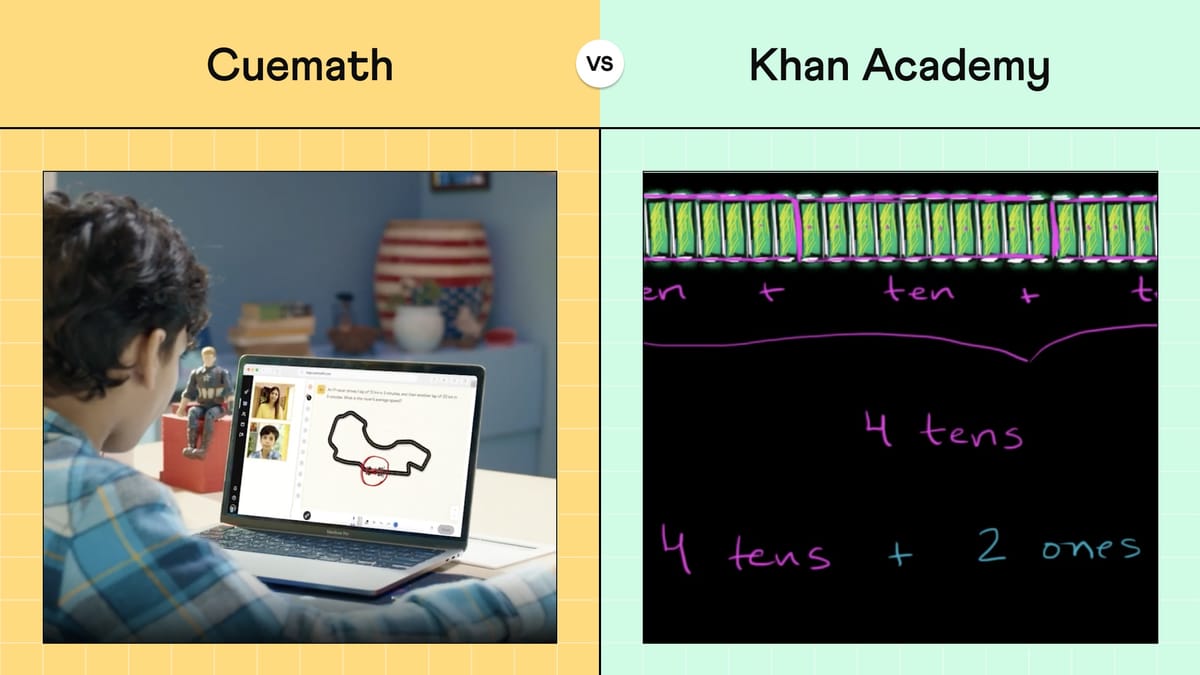
No. Khan Academy has no human tutors. The platform is built around video lessons recorded by founder Sal Khan, along with practice problems and automated feedback. There is no live instruction, no assigned teacher, and no one who knows your child's specific learning patterns. For many families, this is the first limitation they encounter — especially when a child gets stuck on a concept and there is no one to ask.
Is Khan Academy's curriculum aligned with what my child learns in school?
Yes. Khan Academy's CCSS alignment is genuinely strong — arguably the best of any free platform. Parents use it to reinforce the exact topic their child's teacher covered that week. The course library spans Pre-K through AP Calculus, and each skill maps to a specific grade-level standard. Khan Academy is also the only free platform with an official SAT prep program, built in partnership with the College Board.
How does Khan Academy personalize learning for each student?
Khan Academy uses a mastery-based path — students work through skills at their own pace, and the system adjusts which practice problem appears next based on performance. Parents can set the grade level and monitor progress through a parent account. The limitation is that this personalization is algorithmic: it changes which problem appears next, but it cannot identify why a student keeps making the same mistake or adjust the explanation to match how a specific child thinks.
How does Khan Academy keep kids engaged?
Khan Academy uses a points and badges system to incentivize practice. Some students respond well to this; others find it shallow once the novelty wears off. The videos are well-produced and parents consistently praise the quality of Sal's explanations: "Sal's explanations are genuinely great — my 5th grader finally understood fractions." For self-directed students, the platform can hold attention well. For students who need live accountability, the absence of a human relationship is a recurring complaint across parent forums.
How does Khan Academy measure student progress?
The parent account shows which skills have been mastered, practiced, or not yet started. The mastery system is transparent — parents can see exactly where their child is on the grade-level skill map. What it cannot show is why a child is stuck on a skill, whether they are making conceptual errors versus careless mistakes, or what the next instructional step should be. There is no human feedback loop.
One thing to know: Khan Academy works well as a supplement, but it has a ceiling for students who need explanation. US parents describe it consistently across Reddit: "Widely recommended as a starting point. Trusted but passive — it doesn't adapt to my child." Students who prefer a social environment, a live class structure, or external accountability may not find self-paced video learning the right fit.
Best for: Students who are self-directed and don't need a human to stay on track. High schoolers who have a strong math foundation and need SAT practice volume. Homeschool families supplementing a primary curriculum. Cost-conscious parents whose child is performing at grade level and just needs extra practice — not intervention.
Not for: Students who struggle and need someone to explain why they keep getting it wrong. Kids who lose motivation without external accountability. Families who tried Khan Academy already and saw no change in grades — the platform doesn't change if the student's behavior doesn't.
Cuemath vs Khan Academy: Which is Better for Kindergarten?
Cuemath is the stronger pick for kindergarteners.
At this age, a child's relationship with math is shaped almost entirely by the relationship they have with the person teaching them. Self-paced video doesn't land with 5- and 6-year-olds the way a patient, familiar human voice does.
- Cuemath: One tutor, same face every class, trained in child psychology. Sessions use visual manipulatives and short activities designed for young attention spans. Tutors build the habit of enjoying math before formal curriculum begins.
- Khan Academy: Has solid kindergarten content, but the self-directed format requires full parent involvement at every step. At this age, Khan Academy is less a program and more a parent-led activity.
Cuemath vs Khan Academy: Which is Better for Elementary?
Cuemath holds the stronger position for most elementary students.
Elementary school is when foundational gaps form — and when they are easiest to close. A tutor who watches a child work can catch a misconception in minutes; a video can only replay what it already said.
If your child is struggling:
- Cuemath: The MathFit Evaluation identifies the exact gap first. The tutor works from that point, not from the beginning of the grade curriculum. Most parents report visible improvement in 4–6 weeks.
If your child is advanced:
- Cuemath: A tutor can accelerate above grade level within the same session structure. Students in Grades 3–5 have reached AMC 8 qualifying scores and Olympiad Honor Roll through Cuemath's advanced learning track.
- Khan Academy: Has Grade 6–8 content accessible to elementary students, but it's passive. A self-motivated student can work ahead, but no one challenges or extends their thinking in real time.
Cuemath vs Khan Academy: Which is Better for Middle School?
Cuemath has the edge for struggling students. Advanced students may use both.
Middle school is the highest-stakes phase for math. Pre-algebra, algebra, and geometry gaps in Grades 6–8 compound directly into high school failure.
If your child is struggling:
- Cuemath: The MathFit Evaluation pinpoints which foundational skill broke down: fractions, integer operations, and proportional reasoning. The tutor works backward from the specific gap, not from the current grade curriculum.
If your child is advanced:
- Khan Academy: Covers through Pre-Calculus and includes AMC-aligned problem sets. For self-motivated advanced students, it's a useful free supplement alongside live tutoring.
Grade pick: Cuemath for struggling students. For advanced students: Cuemath as the primary program, Khan Academy as a free supplement.
Cuemath vs Khan Academy: Which is Better for High School?
Both have a role — but for different purposes.
High school is where the comparison gets most nuanced. Khan Academy has one genuine advantage at this stage: the official SAT prep partnership with College Board. For structured math learning, Cuemath's 1:1 format wins.
If your child is struggling:
- Cuemath: Algebra II, Precalculus, and Calculus all require live feedback. A student who scored a 55% on a Precalculus test needs someone to review the test with them and identify what broke down. A video can't do that. Cuemath tutors work from the student's specific errors, not a generic lesson plan.
If your child is advanced:
- Khan Academy: The free SAT prep program is genuinely strong. Many families use it alongside Cuemath — Khan Academy for SAT practice volume, Cuemath for conceptual depth and personalized prep.
For many serious SAT students, Khan Academy is where the prep journey starts — not where it ends. Students who push into 1500+ territory typically layer in additional resources once they've built their foundation.
Cuemath vs Khan Academy: Full Comparison
| Feature | Cuemath | Khan Academy |
|---|---|---|
| Teaching Format | Live 1:1 online tutoring — 60 min/session | Self-paced video lessons + practice problems |
| Tutor Consistency | Same dedicated tutor every class | No tutor — fully self-directed |
| Personalization | Tutor adjusts in real time; MathFit Evaluation identifies gaps before session 1 | Algorithmic — adapts which problem comes next, not how the concept is explained |
| Engagement Model | Human accountability — tutor relationship keeps the child returning | Points, badges, and streaks — works for self-motivated students, not for reluctant learners |
| Parent Visibility | Tutor notes after every session + monthly MathFit scores + parent dashboard | Skill mastery map — shows what's done, not why a child is stuck |
| Curriculum | CCSS-aligned, K–12 | CCSS-aligned, Pre-K through AP |
| SAT Prep | ✅ 1:1 structured prep — tutor works from the student's specific errors | ✅ Official SAT program built with College Board — free and comprehensive |
| Competition Math (AMC/AIME) | ✅ Advanced track with structured 1:1 competition prep | ⚡ AMC-style problems available — no guided prep |
| Cost | Starting at $200/month — free trial class + diagnostic | Free — no sign-up required to access content |
| Who It Works Best For | Students who need structure, accountability, and a human to explain — struggling or advanced | Self-directed students who can study independently and don't need live feedback |
| Trustpilot Rating | 4.9/5 (9,000+ reviews) | N/A |
Where Hard Work Turns Into Real Results
Give your child the same structured guidance that helped thousands of students succeed. Try a FREE live Cuemath class today.
200,000+ students • 9,000+ Trustpilot reviews • 4.9+ rating • 80+ countries
Frequently Asked Questions
Is Cuemath better than Khan Academy?
Cuemath and Khan Academy serve different purposes. Cuemath is a live 1:1 tutoring program where a dedicated tutor works with your child every session, tracking their specific gaps and adjusting the lesson in real time. Khan Academy is a free self-paced platform with high-quality videos and CCSS-aligned practice. If your child is struggling or needs structured acceleration, Cuemath is the better choice. If your child is self-directed and needs a free supplement for practice or SAT prep, Khan Academy is excellent.
Is Khan Academy enough for a child who is struggling with math?
Khan Academy can help a struggling student understand concepts through video, but it has a clear ceiling. It cannot identify why a student keeps making the same mistake, and it cannot adjust an explanation to match how a specific child thinks. US parents across Reddit consistently describe it as a "starting point" that hits a wall when a student needs to ask a question. For a student who is genuinely falling behind, a human tutor is usually needed.
What does Cuemath offer that Khan Academy doesn't?
Cuemath offers a live, one-on-one human tutor who knows your child by name, tracks their specific gaps session by session, and adjusts every lesson in real time. It also includes a free MathFit Evaluation (diagnostic), monthly progress reports, tutor notes after every session, and a learning relationship that builds over time. Khan Academy offers none of this — it is a self-directed platform with no human feedback loop.
Is Khan Academy completely free?
Yes. Khan Academy is 100% free. There is no subscription fee, no premium math tier, and no credit card required. The SAT prep program, CCSS-aligned courses, and all practice content are available at no cost to any US student or parent.
How much does Cuemath cost in the US?
Cuemath starts at $200 per month for students in Kindergarten through Grade 7, and $256 per month for Grades 8–12. Each session is 60 minutes of live 1:1 instruction with a dedicated tutor. The first class is free — no credit card required — and includes a MathFit Evaluation assessment. Unused classes are fully refunded with no questions asked.
Can Khan Academy replace a math tutor?
Khan Academy can replace a tutor for students who are self-motivated, on or above grade level, and able to learn effectively from video instruction. It cannot replace a tutor for students who need explanations adapted to their specific thinking, who lack the consistency to self-study without accountability, or who are significantly behind grade level. Most US parents use Khan Academy and a tutor together, not as substitutes for each other.
Which is better for elementary school math — Cuemath or Khan Academy?
Cuemath is the stronger choice for elementary school math (Grades K–5). At this age, the tutor relationship is central to how a child learns — young students build confidence and persistence when a consistent, patient adult is guiding them. Khan Academy is better suited for older, more self-directed students. For elementary students, Khan Academy works well as a practice supplement between Cuemath sessions.
Which is better for high school math — Cuemath or Khan Academy?
For high school math, the best answer depends on the goal. If your child is struggling with Algebra II, Precalculus, or Calculus, Cuemath's 1:1 tutoring provides the live, personalized feedback that a video cannot. If your child is preparing for the SAT, Khan Academy's free official SAT prep program built with College Board is genuinely strong. Many high school families use both: Cuemath for structured math learning and Khan Academy for SAT practice volume.
Can I use Khan Academy and Cuemath at the same time?
Yes, and many families do. A common pattern: Cuemath for live 1:1 sessions one to two times per week, and Khan Academy for practice on off-days or SAT prep work. The two programs don't conflict — Khan Academy's CCSS alignment means its content maps directly to what Cuemath tutors are teaching.
Does Cuemath offer SAT prep?
Cuemath's math depth directly supports SAT performance — students on Cuemath's advanced track have scored 100% on PSAT Math and 790/800 on SAT Math. Cuemath does not offer a standalone SAT prep course, but a tutor can work on SAT-specific content in 1:1 sessions when that is the goal. For SAT practice volume — timed drills, full-length practice tests — Khan Academy's free SAT program is the recommended supplement.
Is Khan Academy good for gifted students?
Khan Academy is a useful resource for gifted students as a free content library. It covers through AP Calculus and AP Statistics and includes AMC-aligned problem sets. The limitation for gifted students is that it is passive — it does not push a student the way a live tutor or structured competition program would. For students aiming for AMC 8/10/12, MATHCOUNTS, or AIME, Cuemath's advanced track or a competition-specific program is the more appropriate choice.
How is Cuemath different from other online math tutoring platforms?
Cuemath differs from marketplace platforms like Varsity Tutors or Wyzant in that it uses a proprietary CCSS-aligned curriculum, a purpose-built teaching platform (LEAP with Cueboard), and a standardized tutor training process. Tutors are selected from the top 1% of STEM applicants and trained in both math pedagogy and child psychology. The MathFit Evaluation and monthly assessments are built into the program structure — not left to individual tutor preference. Compared to Khan Academy, the core difference is human: Cuemath provides a live, dedicated teacher; Khan Academy does not.
Sources
- Khan Academy — About and Mission
- College Board — Official SAT Partnership with Khan Academy
- Trustpilot — Cuemath Customer Reviews (4.9/5, 9,000+ reviews)
- Common Core State Standards Initiative — Mathematics Standards