Cuemath vs. IXL: Which is Better for US Students in 2026?
In this comparison, we review Cuemath and IXL side by side, covering teaching format, pricing, curriculum alignment, and what US parents actually say about both platforms.

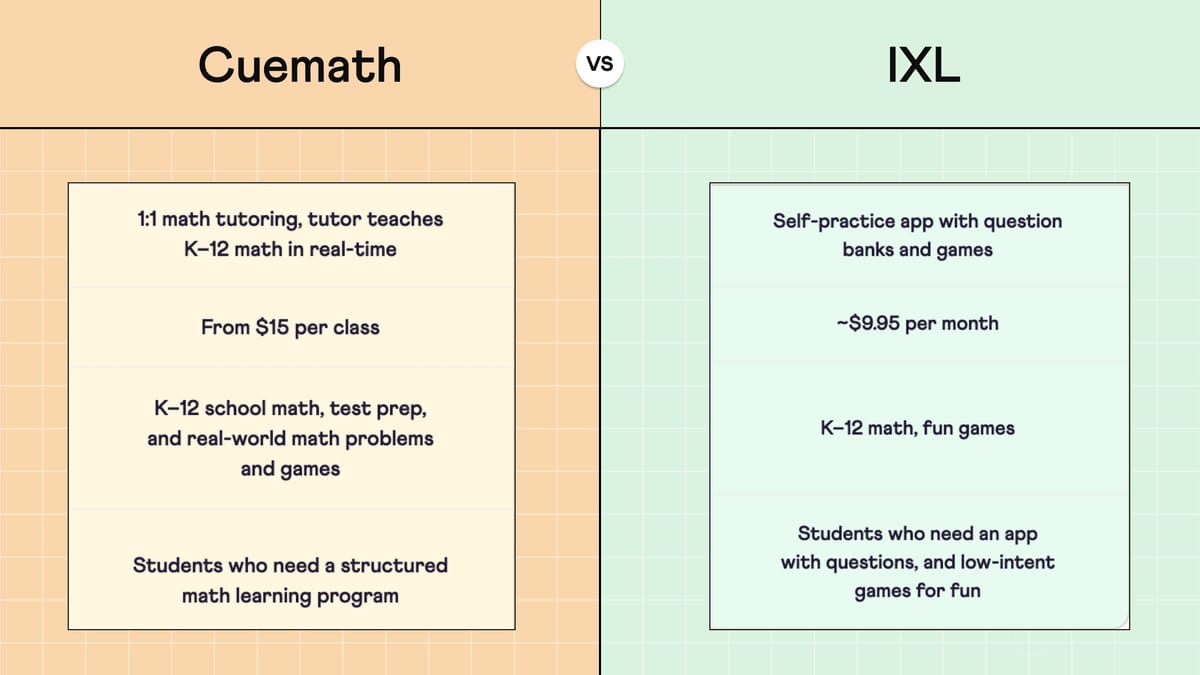
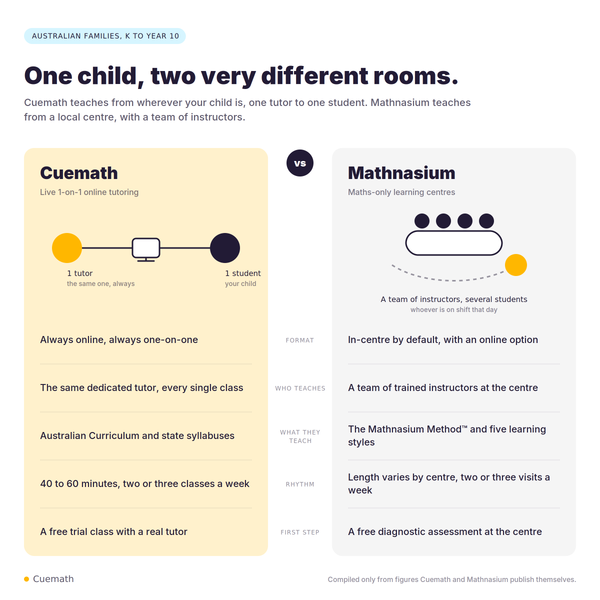
Cuemath teaches Math. IXL is a website where students can practice and test their math skills. That basic difference influences just about everything else about the two programs and how children learn and what parents pay, how engaging the experience is, and what sort of support students get.
Cuemath is a live, one-on-one online tutoring program for K-12 students. A tutor provides one-on-one instruction in concepts, answers questions, identifies learning gaps, and adapts instruction to the child’s pace and goals. Cuemath's curriculum is aligned with common core and state standards in the US.
IXL, in contrast, is a self-paced individualized education platform that relies on interactive practice. It has thousands of skills, tracks student performance, offers real-time analytics, and employs adaptive features to help students work on appropriate skills.
In our view, if your child requires instruction, explanation, and personalized guidance, then generally Cuemath is the better option. IXL might be a good option for a student who already knows the material and needs lots of independent practice.
In this Cuemath vs. IXL review, we’ll be comparing the two programs based on what matters most to US parents: teaching format, curriculum alignment, pricing, engagement, personalization, and parent feedback. We’ll also look at differences by grade level so you can determine which program best matches your child’s actual needs.
- Quick Answer: Cuemath or IXL, Which is Better?
- How Did We Review Cuemath and IXL?
- Cuemath Review
- IXL Review
- Cuemath vs. IXL: Which is Better for Elementary School?
- Cuemath vs IXL: Which Program is Better for Middle School?
- Cuemath vs IXL: Which Program is Better for High School?
- Cuemath vs IXL: Complete Comparison
- Frequently Asked Questions
- Sources
- Cuemath is live 1:1 tutoring with a dedicated tutor; IXL is a self-paced practice platform with no live instruction — this one difference shapes everything else in this comparison.
- Cuemath is the stronger choice for concept-building, math anxiety, and students who need a teacher to explain, not just test.
- IXL is a strong, affordable supplement for students who already understand the material and need more practice, especially if their school already uses it.
- Cuemath starts at $15 per class with one free live class and a MathFit evaluation; IXL starts at about $9.95/month for math with limited free access. (Source: ixl.com)
- Cuemath's curriculum runs through AP Calculus and SAT prep; IXL's coverage is strongest through Algebra 2 and thins out above that.
- On Trustpilot, Cuemath holds 4.9/5 across 11000+ reviews.
Quick Answer: Cuemath or IXL, Which is Better?
| Best For | Winner |
|---|---|
| Best 1:1 Math Tutoring with a Dedicated Expert Tutor | Cuemath |
| Best Adaptive Self-Paced Practice for K–12 | IXL |
| Best for Building Math Concepts from Scratch | Cuemath |
| Best for Tracking Specific CCSS Skill Gaps | IXL |
| Best Value Supplemental Practice Tool | IXL |
| Best for Students with Math Anxiety | Cuemath |
| Best for High School and SAT Math Prep | Cuemath |
Source: cuemath.com · ixl.com
How Did We Review Cuemath and IXL?
To make this comparison as objective and useful as possible, we reviewed the following sources and official information:
- Official product and program information: We reviewed the official websites and product pages for both Cuemath and IXL to understand their teaching formats, features, grade coverage, curriculum, personalization, and learning experience.
- Curriculum and program details: We compared the published curriculum information, skills covered, grade-level offerings, and how each platform supports students at different stages of learning.
- Pricing and enrollment information: We reviewed pricing, trial offers, subscription details, and other published terms to understand the overall cost and commitment for families.
- Program policies and published claims: Where relevant, we considered information about scheduling, cancellation or refund policies, assessments, progress tracking, and other features published by the programs themselves.
Our conclusions are based on the information available from these sources at the time of writing. We distinguish between what each company officially states about its program and experiences or opinions shared by users, rather than treating individual reviews as proof of overall program performance.
Cuemath Review
When parents evaluate a math program, they're not looking for a feature list; they're asking specific questions about their child. We've structured this review around the five questions parents ask most.
| Cuemath — At a Glance | |
|---|---|
| Grades | K–12 |
| Curriculum | US Common Core (CCSS) |
| Format | Live 1:1 online |
| Cost | Starting at $15 per class |
| Free Trial | 1 full class + MathFit Evaluation (no credit card) |
| Commitment | Monthly or annual |
| Trustpilot | 4.9/5 (11k+ reviews) |
Source: cuemath.com
Does Cuemath assign the same tutor every class?
Cuemath personalizes learning by starting with an assessment of the student’s current skills and identifying specific learning gaps. The tutor then uses those results to build a learning plan around the child’s grade level, goals, and areas that need improvement.
Because classes are 1:1, the tutor can adjust the pace and teaching approach in real time. If a student is struggling with a concept from an earlier grade, the tutor can go back and reteach it; if the student is progressing quickly, lessons can move ahead. The same tutor continues to work with the child, allowing the plan to evolve as the student’s needs change.
This makes Cuemath’s personalization more than simply assigning different levels of practice: the tutor adapts what is taught, how it is taught, and how quickly the student moves through the material.
What Cuemath Parents Say About Their Child's Tutor
Source: TrustpilotAnand 🇺🇸 United States
★★★★★
"Ms. Asmita Kukreja helped my child with the transition to US curriculum standards — patient and supportive throughout."
View on Trustpilot →Anjali Verma 🇺🇸 United States
★★★★★
"My son initially struggled a lot with math. Teacher Kanika's patient, clear explanations transformed him from math-averse to enjoying the subject."
View on Trustpilot →Susan 🇺🇸 United States
★★★★★
"Well-structured and engaging — Ms. Zaineb's clear explanations and encouragement made all the difference."
View on Trustpilot →Is Cuemath's curriculum aligned with what my child learns in school?
Yes. Cuemath’s curriculum is aligned with the US Common Core State Standards (CCSS) across K–12. Its lessons include interactive simulations, real-world practice questions, and downloadable PDFs, with learning mapped across four skill dimensions: fluency, understanding, application, and reasoning.
Because the program is taught live by a 1:1 tutor, lessons can be adjusted to match what a student is currently learning at school or move ahead when a family wants to accelerate. This makes Cuemath suitable both for students who need additional support with their current schoolwork and for those who want to work beyond their grade level.
Achievements of Cuemath Students
From SAT scores to Math Olympiads, what consistent 1:1 tutoring builds.
With Cuemath's 1:1 tutoring, Bryan built logic and confidence — now he has aced high-school algebra and ranked #9 nationally in Math Kangaroo.
Cuemath strengthened Aadi's step-by-step thinking — turning raw talent into 99th percentile AMC success and consistent top scores.
Cuemath strengthened her mental math and stepwise logic. Nivriti improved calculation speed, concepts, and accuracy under Olympiad pressure.
Cuemath turned math anxiety into mastery — helping Harshitha excel in AP Calculus, skip college Calc I, and enter a top U.S. business school.
With Cuemath's logic-first tutoring and consistent practice, Midyan achieved a 1520 SAT and 790/800 in Math on his first attempt.
Cuemath's guided practice and US-aligned curriculum shaped Vanya's reasoning, leading her to ace AP Calculus BC and score a 1530 in SAT.
How does Cuemath keep kids engaged?
- Cuemath keeps students engaged through live, interactive 1:1 classes instead of independent practice alone.
- Each session focuses on 1:1 personalized learning. The tutor and student use a shared interactive whiteboard to solve problems and discuss the student’s thinking in real time.
- Tutors are selected from the top 1% of applicants.
- They receive training in child psychology and math, helping them adapt lessons to each child’s learning style.
- Cuemath also uses games, puzzles, and rewards in its practice app to encourage learning between live classes.
- The combination of personal attention, interactive teaching, and game-based practice is designed to make math feel more active and less repetitive.
How does Cuemath measure student progress?
Cuemath measures progress through ongoing assessment and tutor feedback, rather than relying only on scores from individual practice sessions.
- Before classes begin, a skills-and-gaps evaluation identifies areas where the student may be struggling, helping the tutor create a personalized learning plan.
- During live 1:1 sessions, the tutor can monitor how the student approaches problems, identify misconceptions, and adjust instruction in real time.
- Cuemath also tracks how much the child talks and reasons during class, giving the tutor insight into the student's mathematical thinking rather than looking only at whether an answer is correct.
- Parents can follow their child's progress through the parent app, giving them visibility into how their child is developing over time.
The key difference is that progress is measured not just by correct answers, but also by understanding, reasoning, and improvement in specific skill gaps.
Cuemath's Considerations: Cuemath is designed as a premium, structured math-learning program, with 40-minute sessions twice a week starting at $15 per class. For families looking to make a sustained investment in their child's mathematical foundation, the format offers consistent instruction and personalized support over time.
For students who already have a strong grasp of the material and only need occasional practice or extra problem-solving, a lighter practice-focused platform may be a more practical fit.
Best for: Students who benefit from a dedicated tutor to build genuine mathematical understanding, strengthen foundations, and progress with consistent support. Grades K–12.
May be less necessary for: Students who already understand the material and primarily need an affordable, flexible way to reinforce skills through occasional practice.
IXL Review
We applied the same parent-first lens to IXL: the same five questions, answered directly, so you can compare the two programs fairly and see which one better fits your child’s learning needs.
| IXL — At a Glance | |
|---|---|
| Grades | K–12 |
| Curriculum | US Common Core (CCSS) |
| Format | Self-paced adaptive (no live instruction) |
| Cost | Starting at ~$9.95/month (math only) |
| Free Trial | Limited free access |
| Commitment | Monthly; cancel anytime |
Source: ixl.com
Does IXL assign the same tutor every class?
No. IXL does not use a tutor-based model. It is a self-paced, practice-focused learning platform where students work independently through interactive math skills.
There are no scheduled 1:1 tutoring sessions or live instruction. Instead, your child logs in, selects a skill, and works through practice problems at their own pace. IXL provides feedback as students work and uses performance data to guide their practice.
That is not necessarily a drawback; it reflects what IXL is designed to do. For students who are comfortable learning independently and need regular opportunities to practice, reinforce, and assess math skills, this model can offer considerable flexibility without requiring a fixed tutoring schedule.
Is IXL's curriculum aligned with what my child learns in school?
Yes. Curriculum alignment is one of IXL’s clearest strengths. IXL organizes its math skills by grade level and aligns them with the Common Core standards, making it easier for students to practice concepts they are learning in school.
The platform offers thousands of math skills across K–12, allowing students to work on specific concepts rather than completing a broad set of problems without a clear connection to their schoolwork. This granular skill structure is also one reason IXL is used by schools and teachers as a classroom practice and assessment tool.
For families, this can be especially convenient when a child needs extra practice on a skill they are currently learning in school. If your child’s school already uses IXL, they may also have access through the school rather than needing a separate family subscription.
How does IXL personalize learning for each student?
IXL personalizes learning primarily through adaptive practice. As a student answers questions within a skill, the difficulty adjusts based on their performance. Correct answers can lead to more challenging questions, while incorrect answers can bring the difficulty back down.
This is different from adaptive instruction. IXL adjusts the questions a student receives, but it does not provide a live teacher who can identify a misunderstanding, explain why an answer is incorrect, or introduce a concept from scratch. The student is still responsible for working through the skill independently.
IXL also uses its SmartScore system to track progress toward mastery on each skill on a 0–100 scale. This gives students and parents a clear way to see how much of a skill has been mastered. However, the scoring system can feel demanding for students who are sensitive to mistakes, since an incorrect answer can cause the SmartScore to fall noticeably, even after a strong run of correct answers.
For students who are comfortable learning independently, this system can provide a structured way to practice and work toward mastery. For students who need explanations or reassurance when they make mistakes, adaptive practice may not provide the same level of support as live, personalized instruction.
How does IXL keep kids engaged?
IXL’s engagement depends largely on how the platform is used.
- At home, younger students may enjoy the awards and visual feedback.
- Short practice sessions can feel manageable and motivating.
- IXL may work well as a brief daily warm-up rather than a long assignment.
- Immediate feedback helps students see their progress.
- Completing skills and earning awards can give students a sense of accomplishment.
The experience may change when IXL is assigned as mandatory homework.
- A required score can make practice feel more like a test.
- The SmartScore system may make mistakes feel more significant.
- Losing points after an incorrect answer can discourage some students.
- Independent learners may enjoy the short, measurable challenges.
- Students who are sensitive to mistakes or score pressure may find the experience less motivating.
How does IXL measure student progress?
- Progress & Growth report: IXL summarizes a student’s progress across skills and assessments.
- Skill proficiency and mastery: The report shows how many skills a student has reached proficiency or mastery in.
Diagnostic growth: IXL’s diagnostic assessments can show a student's
- Starting level
- Current level
- Overall growth during the school year
- Subject-level details: Progress can be reviewed by individual student and subject, such as math or language arts.
- Year-to-date growth chart: A visual chart shows how the student’s performance has changed over time.
- Pinpointed levels: Diagnostic growth is available once IXL has gathered enough information to determine a student’s current level.
- Gathering data: If IXL has not collected enough information, the report displays “Gathering data.”
- Identifying support needs: These reports give parents more context than individual practice scores and can help identify areas where a student may need additional support.
IXL's limitation: IXL is primarily designed as a practice and assessment platform, so its strength is helping students identify skills that need more practice and giving them repeated opportunities to work on those skills. It is less focused on replacing a teacher or providing step-by-step instruction when a student encounters a concept they do not understand.
For a student who needs an explanation before they can move forward, this distinction matters. IXL can show that a child is struggling with a particular skill, but the practice format may not provide the same depth of personalized explanation as a live tutor. In those cases, parents may choose to pair IXL with a teacher, tutor, or another resource that can explain the underlying concept.
Best for: Families looking for an affordable, self-paced supplement for structured math practice and skill-gap tracking. It can be especially useful for students whose schools already use IXL, as well as students who are on track academically and would benefit from additional practice volume.
May be less suitable for: Students who are learning a concept for the first time, need frequent encouragement to stay engaged, or benefit from having a teacher explain why an answer is incorrect. In these situations, IXL can work well alongside a tutor or other instructional resource rather than as the student's only source of math support.
Where Hard Work Turns Into Real Results
Give your child the same structured guidance that helped thousands of students succeed. Try a FREE Evaluation today.
200,000+ students · 4.9+ Trustpilot Rating · 80+ countries
Cuemath vs. IXL: Which is Better for Elementary School?
Cuemath is the stronger primary program for elementary students. At this stage, building a strong mathematical foundation often requires more than repeated practice. A tutor can identify where a child is confused, adjust the explanation, and redirect them in real time.
- Cuemath: 1:1 sessions with a tutor trained in math and child psychology. Lessons focus on building number sense, fractions, and early algebra foundations through guided learning. Because the tutor works directly with the child, they can recognize when a student is struggling and adapt the lesson accordingly.
- IXL: A strong supplemental practice tool for skills that have already been introduced. Short, 10–15-minute practice sessions can work well as a morning warm-up or reinforcement activity. Awards and visual feedback can also make independent practice more engaging for younger students.
Cuemath vs IXL: Which Program is Better for Middle School?
It depends on what the student needs. Middle school is an important stage for building algebraic thinking, and this is often when earlier gaps can become more noticeable. Students who need concepts explained may benefit from a more guided approach, while students who already understand the material may get more value from additional independent practice.
- Cuemath: Best suited for students who are behind, need greater confidence, or want help understanding abstract topics such as ratios, expressions, integers, and geometry. The 1:1 tutor can explain concepts, adjust the pace, and provide support when a student gets stuck.
- IXL: Best suited for students who are on track and need more practice volume. Its detailed Common Core-aligned skill structure makes it useful for targeted practice and reinforcing concepts that students have already learned in class.
- Choose Cuemath if: Your child needs someone to explain and teach the concept, not simply provide more questions to answer.
- Choose IXL if your child understands the concepts and needs structured, self-paced repetition to strengthen and reinforce those skills.
Cuemath vs IXL: Which Program is Better for High School?
Cuemath has the stronger case at the high school level, particularly for students who need advanced instruction or preparation beyond core algebra. IXL provides strong skill-based practice through Algebra 1, Geometry, and Algebra 2, but students looking for more advanced coursework or dedicated test preparation may need additional resources.
- Cuemath: Offers a K–12 curriculum that extends through Precalculus, AP Calculus, and SAT/ACT math preparation. For students in Grades 8–12, 6-month and 12-month plans include a free SAT Prep Suite valued at $499. Continuing with the same tutor throughout high school can also provide consistency as the material becomes more challenging.
- IXL: A strong option for Algebra 1, Geometry, and Algebra 2 practice, particularly when students need targeted reinforcement of specific skills or preparation for foundational state assessments. Its role is primarily practice and skill reinforcement rather than advanced live instruction.
- If the goal is AP, SAT, or advanced math: Cuemath is the clearer choice based on its broader high school offering and dedicated preparation options.
- If the goal is reinforcing Algebra 1 or Geometry skills: IXL can be an effective, affordable supplement for students who already understand the concepts and need additional practice.
Cuemath vs IXL: Complete Comparison
| Feature | Cuemath | IXL |
|---|---|---|
| Teaching format | Live 1:1 with dedicated tutor | Self-paced adaptive practice (no live instruction) |
| Grade levels | K–12 | K–12 |
| Curriculum | US Common Core (CCSS) | US Common Core (CCSS) |
| Concept teaching | Yes; tutor explains and guides | Minimal; brief explanations on wrong answers |
| Human teacher | Yes | No |
| Scheduling | Twice a week, 40 min sessions | Anytime, no schedule required |
| Progress tracking | Tutor notes + monthly MathFit Score | Detailed skill dashboard + SmartScore |
| SAT/test prep | Yes; included in high school plans | Limited (Algebra/Geometry review only) |
| Free trial | 1 full live class + MathFit Evaluation | Limited free access |
| Starting cost | $15 per class | ~$9.95/month |
| Best for | Students who need teaching + guidance | Students who need practice + skill tracking |
Where Hard Work Turns Into Real Results
Give your child the same structured guidance that helped thousands of students succeed. Book a FREE Evaluation today.
200,000+ students · 4.9+ Trustpilot Rating · 80+ countries
Final Thought
Cuemath and IXL Learning are both useful for improving math skills, but they take different approaches to learning. IXL is all about practice and repetition, whereas Cuemath is more about understanding concepts, problem-solving, and mathematical thinking. This makes Cuemath a more powerful option for students who want more than just the right answer; they want to understand how and why a solution works.
Cuemath's methodology is different, as it mixes interactive learning with a strong focus on reasoning to create an experience that helps students become more confident, independent, and fit at math. The focus on meaningful understanding in Cuemath gives it an edge that goes further than simply practicing more problems.
Frequently Asked Questions
Is Cuemath better than IXL?
Cuemath and IXL serve different purposes, so "better" depends on what your child needs. Cuemath is a live 1:1 tutoring program that is better for concept building, personalized instruction, and students who need a teacher to explain concepts. IXL is a self-paced practice platform, better for supplemental drill, gap-tracking, and affordable independent practice. For primary math instruction, Cuemath is the stronger choice. For a low-cost supplement, IXL is effective.
What is the main difference between Cuemath and IXL?
The main difference between Cuemath and IXL is the format. Cuemath is live 1:1 tutoring with a tutor in every session. IXL is a self-paced digital platform with no live instruction. Cuemath teaches new concepts; IXL tests and drills concepts already learned. They are fundamentally different tools built for different purposes.
How much does Cuemath cost compared to IXL?
Cuemath starts at $15 per class. IXL starts at approximately $9.95/month for math-only access, or $19.95/month for all subjects. The price difference reflects the format: Cuemath includes live 1:1 sessions per month with a dedicated expert tutor; IXL is unlimited self-paced digital practice with no human instruction.
Does IXL have a free trial?
IXL offers limited free access, allowing students to try a set number of practice questions before a paid subscription is required. Cuemath offers one full live 1:1 class plus a MathFit evaluation at no cost; no credit card is required.
Is IXL good for math?
IXL is a useful math practice tool, particularly for reinforcing skills already taught in school. Its strength is the granular Common Core skill coverage and detailed parent reporting. Its limitation is that IXL does not teach; it tests. Students who are stuck on a concept will not get an explanation from IXL; they will be marked wrong and asked to try again. For drill practice and skill-gap identification, IXL is effective. For learning new concepts, a teaching program like Cuemath is needed.
Does IXL teach math or just test it?
IXL primarily tests and drills math skills rather than teaching them. When a student gets a question wrong, IXL provides a brief explanation, but this is minimal compared to what a live tutor provides. IXL is best understood as a practice and assessment platform, not a teaching platform. Families who use IXL most effectively tend to pair it with live instruction.
What grade levels do Cuemath and IXL cover?
Both Cuemath and IXL cover kindergarten through grade 12. Cuemath's curriculum is aligned to US Common Core State Standards across all K–12 grades, including advanced high school topics. IXL covers 4,500+ skills across K–12, also CCSS-aligned, with strongest coverage through Algebra 2. At the high school level, Cuemath's live tutoring extends through AP Calculus and SAT prep, areas where IXL's coverage is limited.
Is IXL good for students with math anxiety?
IXL's SmartScore system, where a single wrong answer can drop the score significantly even after many correct ones, is frequently cited by parents and educators as increasing math anxiety rather than reducing it. For students already anxious about math, the punitive scoring mechanic can make practice feel high-stakes. Cuemath's approach, where tutors trained in child psychology guide students through mistakes as learning moments, is better suited for students who need confidence alongside content.
Can I use both Cuemath and IXL together?
Yes, Cuemath and IXL can be used together effectively. Cuemath provides the teaching and conceptual foundation during twice-weekly live sessions. IXL can be used for 10–15 minutes of daily practice between sessions to reinforce specific skills. Parents who use both tend to report stronger outcomes than either alone, but the primary investment should go toward the live instruction.
Which is better for SAT math prep, Cuemath or IXL?
Cuemath is the stronger choice for SAT math preparation. The 6-month and 12-month plans for Grades 8–12 include a free SAT material valued at $499. Cuemath tutors can target sessions specifically at SAT Math content areas, and the same tutor who knows your child's weak areas works on them strategically across the full prep period. IXL supports Algebra and Geometry review, which are SAT-relevant, but does not offer a structured SAT prep path.
How does Cuemath track student progress?
Cuemath tracks student progress in two layers. After each session, the tutor provides notes on what was covered and how the student performed. Monthly, students in grades 3–8 receive a MathFit score on a 3–10 scale across four dimensions: fluency, understanding, application, and reasoning. Parents can track this score over time and see the arc of measurable improvement.
How does IXL track student progress?
IXL tracks student progress through the SmartScore system, which measures mastery of each skill on a 0–100 scale. Parents can access a dashboard showing which skills have been practiced, which are at mastery level, how much time was spent, and where gaps exist across the CCSS skill tree. This reporting is detailed and specific, and it is one of IXL's genuine strengths for parents who want visibility into exactly where their child stands.
Sources
- IXL — Official Math Program
- Cuemath Trustpilot Reviews—4.9/5 from 11000+ reviews
- US Common Core State Standards for Mathematics

I was never the kid who loved math. I was much more interested in books, stories, and writing—and, somewhere along the way, I became even more curious about people. Why do we learn differently? Why does something make sense to one child but not another? And what makes a student feel confident enough to keep trying?
That curiosity led me to study Applied Psychology, where I learned more about how children think, learn, and make sense of the world around them.
My love for writing did the rest. What started as something I simply enjoyed became a career. Over the past five years, I've worked as a freelance writer across edtech, SaaS, B2B, travel, lifestyle, and healthcare, learning how to write for very different audiences without losing the human side of the story.
Today, I'm an SEO Content Writer & Editor at Cuemath, where I get to bring many of these interests together. Working in education—and especially around math—has made me even more curious about what happens behind the screen or textbook: what parents worry about, what students struggle with, and what actually helps them learn.
That's also how I like to research. I don't just look at search results and call it a day. I go where parents and students actually talk—forums, reviews, communities, and conversations with real families. Because sometimes the most useful insight isn't hiding in a keyword; it's in a parent's question, a student's frustration, or a small detail someone shares about their learning experience.
I write because I'm curious. I research because I want to understand. And I love turning what I learn into content that feels genuinely useful to the people reading it.