Back-to-School Math Activities for Elementary Students
14 hands-on back-to-school math activities for elementary students, from counting and shapes early on to multiplication, estimation, and place value later. Each uses everyday materials, has three levels, and comes with a comparison table. Recommended by Cuemath tutors.

Summer break is ending, and a new school year is about to begin. Some kids are going back to a familiar grade. Others are moving up to a harder one. After weeks away from numbers, math can feel rusty, and some kids worry they have fallen behind.
These back-to-school math activities ease kids back in. They don't feel like review. They feel like games: sorting piles, hunting for hidden squares, chanting times tables, racing to fill a bingo card. Little by little, math feels easy and fun again, so no child feels lost in the first weeks.
A good start does more than reteach last year. It gets kids excited, closes the summer slide, and shows them early that math can be hands-on and worth showing up for. When kids move, talk, and touch their way through an idea, they remember it far better than they would from a worksheet.
This guide has 14 hands-on activities for two age groups: 6 for early elementary (grades K to 1) covering counting, sorting, shapes, and patterns, and 8 for upper elementary (grades 2 to 5) covering estimation, multiplication, place value, and reasoning.
These 14 activities are recommended by Cuemath tutors who teach elementary math every day. Our tutors use games like these in class, and they share them with parents to use at home.
Every activity gives you a clear goal, a short list of what you need, easy steps, and three levels so you can match it to your child. You also get a quick way to check if it clicked, and how long it takes. A comparison table and at-home ideas are at the end. Last reviewed: July 2026.
- How Do These Math Activities Help Elementary Students Learn?
- Math Activities for Early Elementary (Grades K-1)
- 1. Sorting Objects
- 2. Simon Says, Math Edition
- 3. Garbage Card Game
- 4. Pattern Block Pictures
- 5. Outdoor Number Hop
- 6. Crayon Counting Cards
- Math Activities for Upper Elementary (Grades 2-5)
- 1. Shape Counting Maze
- 2. What's the Question
- 3. Estimation Challenge
- 4. Math Bingo
- 5. Grid Multiplication Puzzle
- 6. Odd One Out
- 7. Fizz Buzz Chant
- 8. Place Value Puzzles
- All 14 Elementary Math Activities at a Glance
- Elementary Math Activities for Home
- Elementary Math Activities for Summer
- Math Games and Tutoring Cuemath Tutors Recommend
- Frequently Asked Questions
How Do These Math Activities Help Elementary Students Learn?
These math activities help elementary students because they teach the idea before the symbol. A child who groups real objects, builds a pattern, or acts out a times table understands what the math means, not just how to write it down.
Three things make these back-to-school activities work:
- Real things first. Moving real objects builds understanding that a worksheet cannot.
- Movement keeps focus. Short, active games hold attention far better than sitting still, especially in the first weeks back.
- Talking makes it stick. When a child explains their thinking out loud, the learning stays.
This is how Cuemath tutors teach elementary math in their 1:1 classes. They start with something a child can see and do, then link it to the number, the step, or the rule. The activities below work the same way, using everyday things you already have.
Math Activities for Early Elementary (Grades K-1)
These six activities suit kids in kindergarten and first grade (about ages 4 to 7). They build the basics every young child needs: counting, comparing amounts, naming shapes, putting numbers in order, and matching a number to how many. If your child is in kindergarten, our fuller guide to back-to-school math activities for kindergarten covers these early skills in more detail.
1. Sorting Objects: Group, Count, and Compare
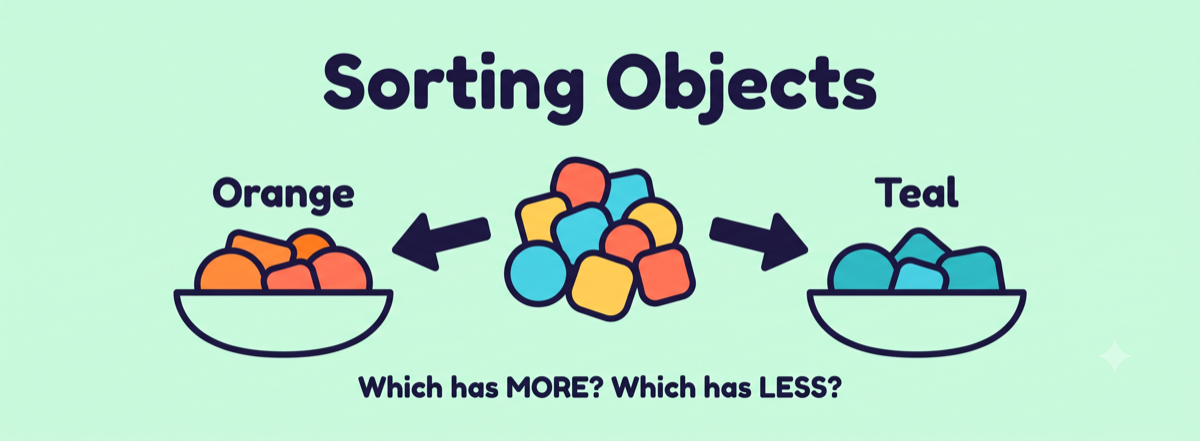
Skill: Sorting and comparing groups by color, size, or shape, and learning the words "more, less, and equal".
You'll need: A pile of small toys, blocks, or buttons; two or three bowls labeled by category; and paper for recording counts.
How to play: Give each child a mixed set of objects and ask them to sort by one attribute (color, shape, or size). Count each group aloud together, then compare: "Which group has more? Which has less? Are any equal?"
Three levels:
- Just starting: Sort by one clear feature (two colors only) using labeled bowls.
- On level: The child sorts by any attribute they choose and counts each group independently.
- Ready for more: Sort by two things at once (size and color), or compare groups of different sizes out loud.
Quick check: Ask "How many are in the red group? How do you know which group is bigger?" Listen for one-to-one counting and correct comparison words. Time: 10 to 15 minutes. Use age-appropriate objects, no small choking hazards.
2. Simon Says, Math Edition: Counting Through Movement
Skill: Counting and position words through movement, like counting actions and words for where things are. You'll need: nothing but an open space.
How to play: Play Simon Says with math commands: "Simon says hop 5 times," "Simon says clap 6 times," or "Simon says point to something taller than you." Children act only when the command starts with "Simon says." After a few rounds, let children take turns as Simon.
Three levels:
- Just starting: Low counts (1 to 5) and simple actions like jump, clap, or tap.
- On level: Counts to 10 to 15, plus position words ("hop to the left side of the mat").
- Ready for more: Combine two instructions ("clap 3 times, then jump twice, how many actions in total?").
Quick check: Watch counting accuracy during actions. Can children count to 10 without losing track? Time: 5 to 10 minutes. Play in an open, obstacle-free space.
3. Garbage Card Game: Ordering Numbers to 10
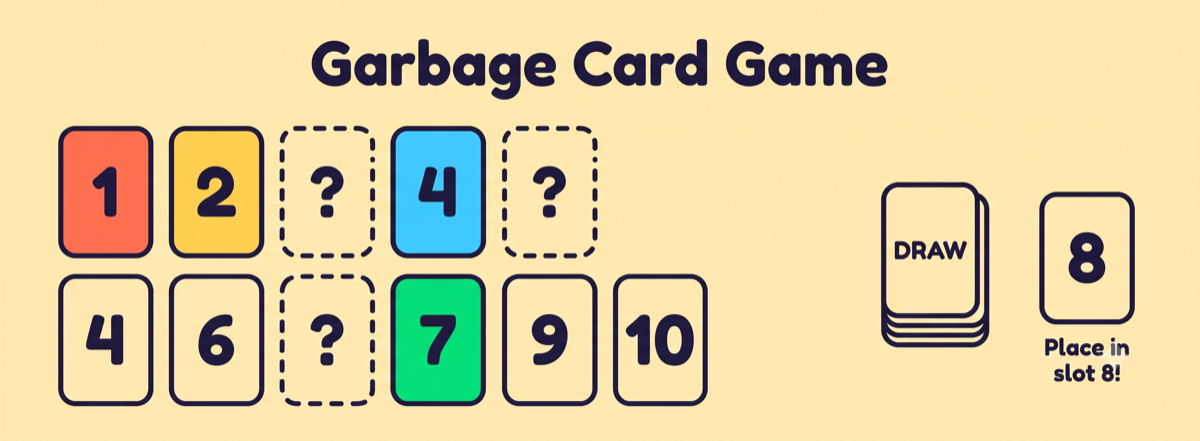
Skill: Number recognition, counting, and ordering to 10, plus turn-taking. You'll need: a standard deck with jokers removed (Ace = 1, face cards are wild or invalid).
How to play: In pairs, each player lays out 10 cards face-down in two rows of five, standing for slots 1 to 10. On each turn, a player draws a card, says its value aloud, and places it face-up in the matching slot. If the slot is filled or the card is a face card, the turn ends. First to fill all 10 slots wins.
Three levels:
- Just starting: Use only slots 1 to 5 and cards 1 to 5.
- On level: Full 1 to 10 game as described.
- Ready for more: Extend to slots 1 to 15, or add a rule where two drawn cards are placed at their sum.
Quick check: Ask "Why did you place that card in slot 4?" to be sure the child connects the number to its spot. Time: 10 to 15 minutes.
4. Pattern Block Pictures: Naming 2D Shapes
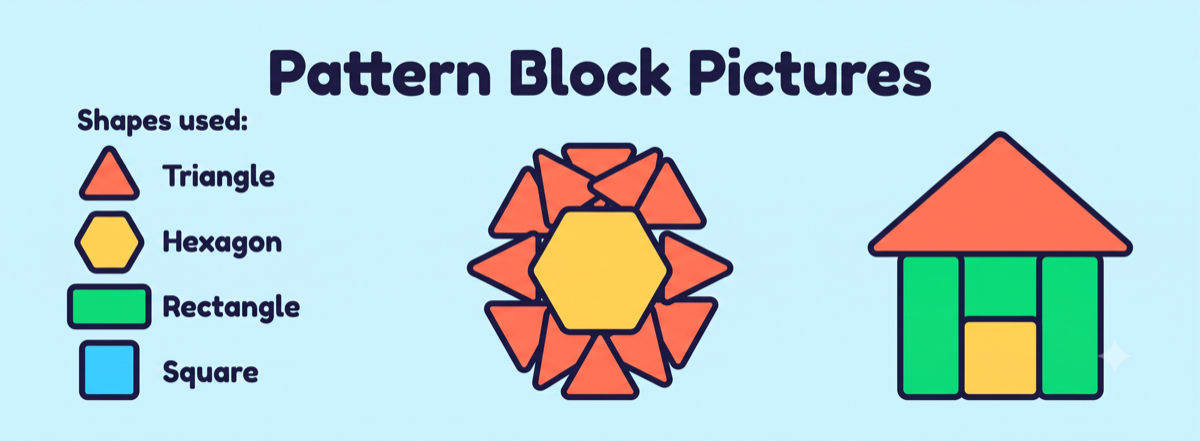
Skill: Naming 2D shapes (hexagon, triangle, square, rhombus, rectangle) and seeing how shapes fit together. You'll need: sets of pattern blocks and printed picture templates (a flower, butterfly, or house outline).
How to play: Give each child a template and blocks. Challenge them to cover the outline completely, naming each shape as they place it. Ask: "What shape is this? How do you know? How many sides does it have?"
Three levels:
- Just starting: Templates that need only one block type (all squares).
- On level: Mixed templates; children name each shape and count how many of each they used.
- Ready for more: Children design their own picture, record every shape used, and describe each shape's properties.
Quick check: "I see you used 6 triangles. What shape do they make together?" This checks whether children see how small shapes combine into larger ones. Time: 15 to 20 minutes.
5. Outdoor Number Hop: Number Sequence with Movement
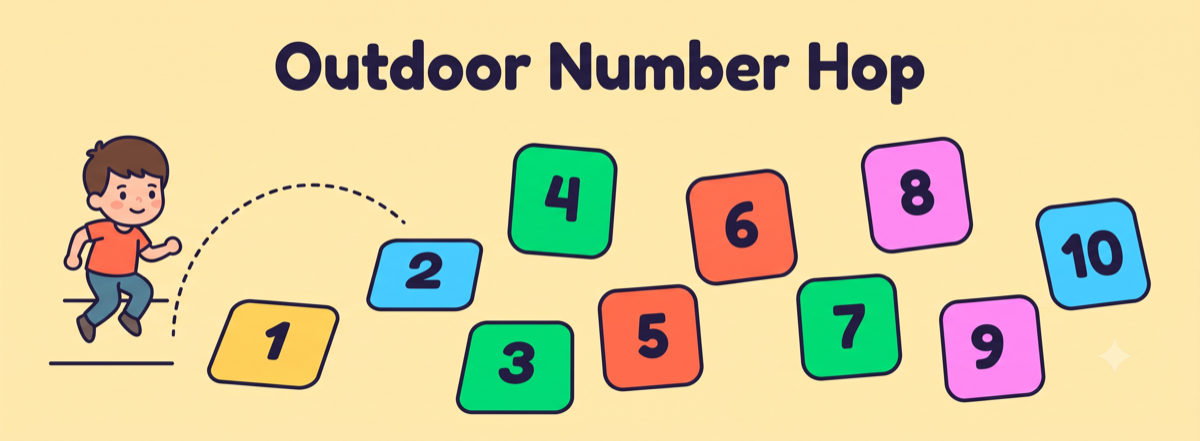
Skill: Moving the whole body while counting and putting numbers in order (1 to 10). You'll need: sidewalk chalk outdoors or masking tape indoors, and open floor space.
How to play: Draw large numbered squares on the ground in a scattered layout, not in order. Stand children at a start line and call a direction: "Hop to number 7!" or "Tiptoe to number 3!" Children move to the correct square. Rotate who calls the directions.
Three levels:
- Just starting: Numbers 1 to 5 placed close together.
- On level: Full 1 to 10 layout, plus "What comes before or after this number?"
- Ready for more: Add simple operations: "Hop to 2, then add 3, where do you land?"
Quick check: Ask "What number comes before 7?" while the child stands on a square. A wrong hop is a teaching moment, not a correction. Time: 10 to 15 minutes. Check the area for hazards and supervise active play.
6. Crayon Counting Cards: Counting and Early Addition
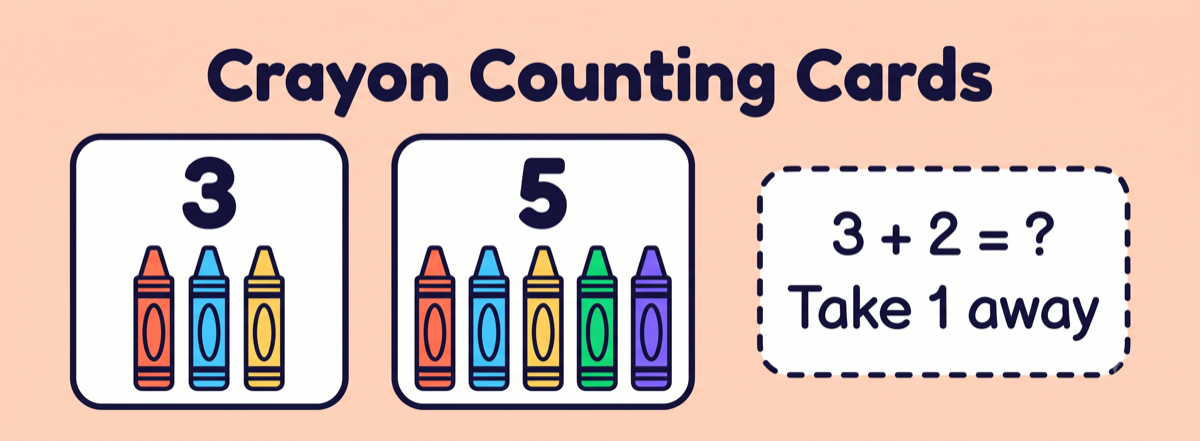
Skill: Matching a number to how many, counting each one once, and early adding and taking away. You'll need: number cards (a number with that many crayon pictures) and real crayons or counters.
How to play: Give each child a card showing a number. The child places that many real crayons to match. Then ask: "If I give you 2 more, how many now? If you put 1 back, how many are left?" Using real crayons lets children touch and count as they go.
Three levels:
- Just starting: Cards up to 5, matching only, no addition yet.
- On level: Cards up to 10, with simple addition and subtraction within 10.
- Ready for more: Combine two cards ("What is 3 plus 4?") by merging two piles to see how numbers combine.
Quick check: "Can you show me 7 with the crayons? Now show me one more than 7." This checks whether the child understands "one more" as a concept. Time: 10 to 15 minutes.
Want a Tutor Who Teaches Math This Way?
Cuemath's 1:1 classes for grades K to 5 use this same hands-on approach, guided by a tutor who adapts every activity to your child. The first class is free.
Book a Free ClassFree 1:1 class · Grades K to 5 · No credit card needed
Math Activities for Upper Elementary (Grades 2-5)
These eight activities suit kids in grades 2 to 5 (about ages 6 to 11). They go past basic counting into reasoning, quick math facts, multiplication, estimation, and place value. All of them need little to no prep, so they work as a warm-up, a quick break, or the main game.
1. Shape Counting Maze: Counting Hidden Squares
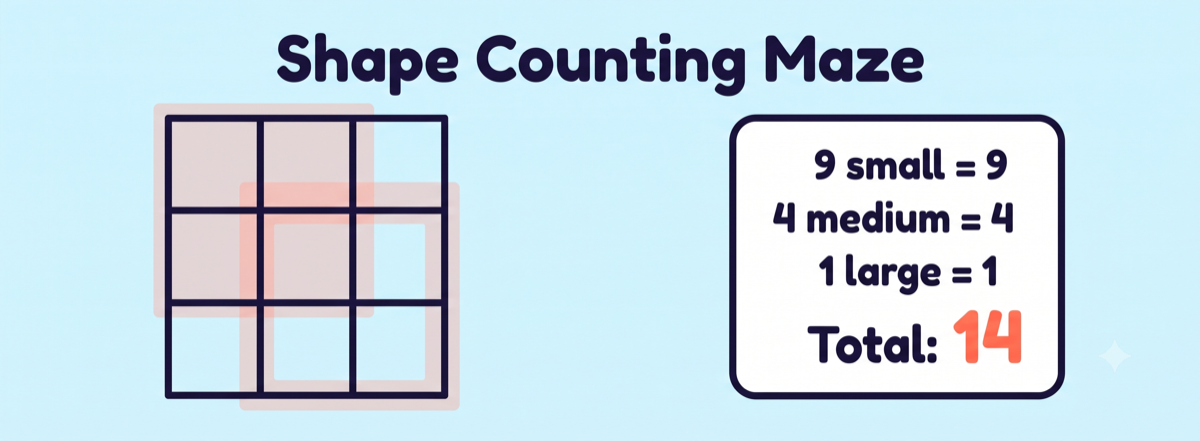
Skill: Counting carefully by finding hidden, overlapping squares of different sizes in a picture. You'll need: a printed grid of overlapping shapes and pencils.
How to play: Give out the diagram and ask: "How many small 1x1 squares? How many 2x2? Does the whole 3x3 grid count too?" Students work in pairs, mark each square they find, then share totals and explain their counting strategy.
Three levels:
- Just starting: Provide a small, medium, large checklist and work through one size together first.
- On level: Students find all squares independently, then compare answers.
- Ready for more: Students design their own "find all the shapes" puzzle for a classmate.
Quick check: "Can you explain your counting strategy?" A correct total with a weak explanation reveals procedure without understanding. Time: 10 to 20 minutes.
2. What's the Question: Practicing Math Facts
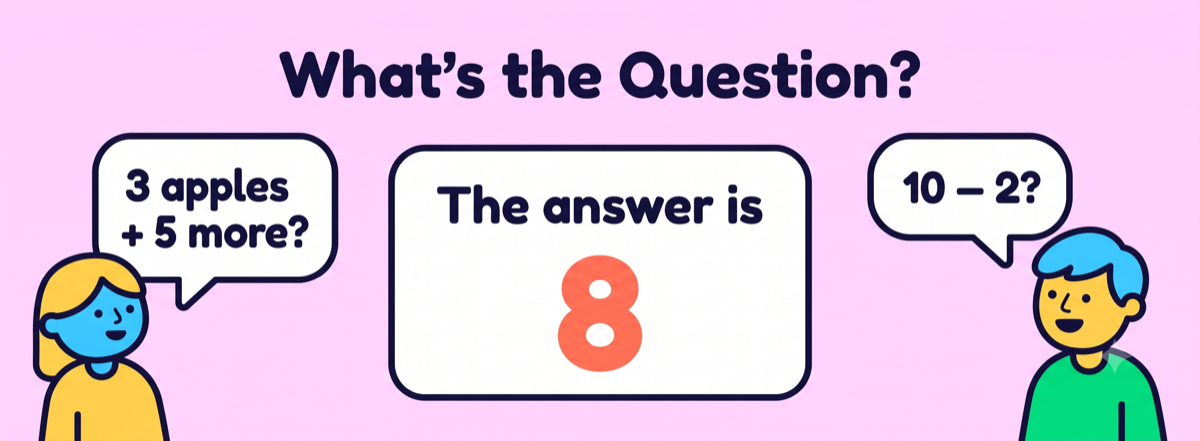
Skill: Quick math facts and making up problems; kids turn an answer into a word problem. You'll need: answer cards ("8", "24", "15") and whiteboards or paper.
How to play: Show an answer with no context, for example "The answer is 8." Students invent a real-world question whose answer is 8, like "I had 3 apples and picked 5 more." Pairs share their problems, and the class checks that the arithmetic works.
Three levels:
- Just starting: Provide key vocabulary ("altogether", "remaining", "shared between") for students who need it.
- On level: Single-operation answers (8, 12, 20).
- Ready for more: Multi-step answers such as 24 = 6 x 4, which require more complex phrasing.
Quick check: "Does your problem actually give the answer 8? Walk me through the math." This checks both accuracy and language. Time: 10 to 15 minutes.
3. Estimation Challenge: Estimating Large Quantities
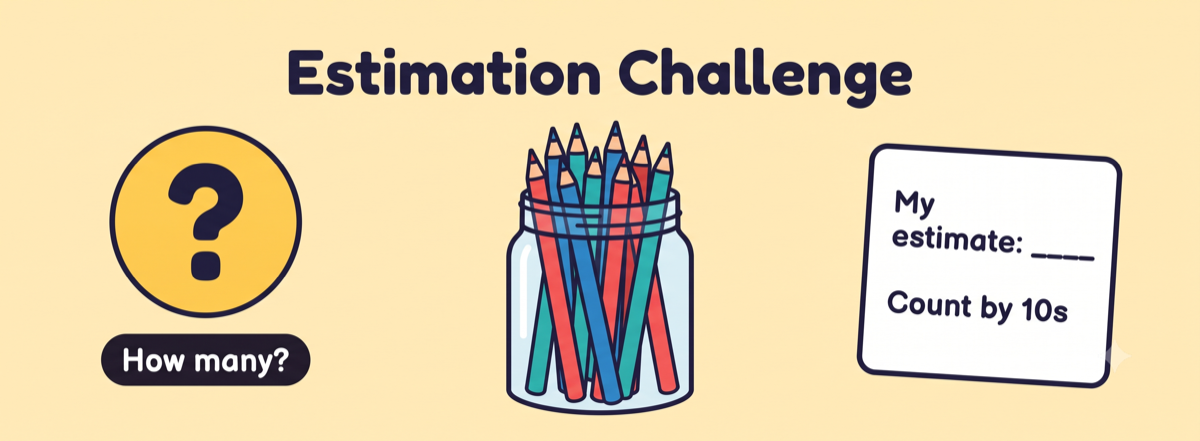
Skill: Estimating and counting large quantities and linking math to real objects. You'll need: items to estimate (a box of pencils, a jar of counters) and paper for guesses.
How to play: Hold up a container and ask "How many pencils do you think are in here?" Students write a private estimate. Count together, grouping by tens to stay efficient. Reveal whose estimate was closest and discuss the strategies used.
Three levels:
- Just starting: Smaller quantities (under 20), counted in ones together.
- On level: Quantities of 30 to 60; students group by tens.
- Ready for more: Add a cost challenge ("Each pencil costs 20 cents, about how much is the whole box worth?") to connect estimation to multiplication.
Quick check: "How did you arrive at your estimate?" "I counted 10, then multiplied" shows real reasoning; "I just guessed" means grouping needs to be modeled. Time: 15 to 20 minutes.
4. Math Bingo: Practicing Number Facts
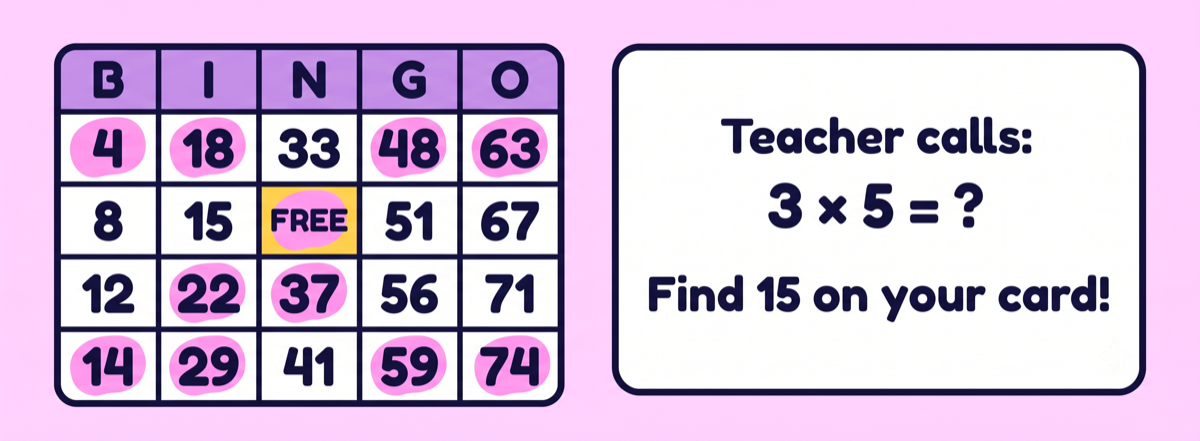
Skill: Reinforcing number facts (addition, multiplication, or fractions) in a low-pressure game. You'll need: blank 4x4 grids, a list of target answers, and markers.
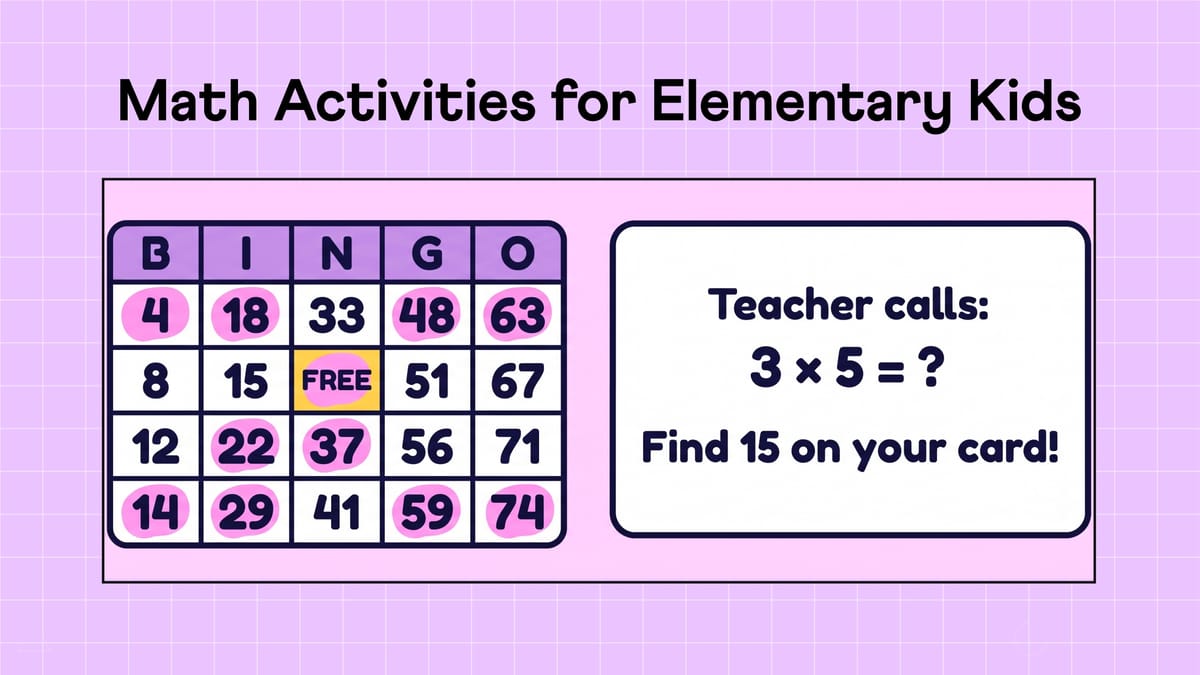
How to play: Pick a theme, for example multiples of 5 between 5 and 50. Students fill their grid with numbers from that range. Call out clues ("3 x 5 = ?") and students cross off the matching answer. First to complete a row, column, or diagonal calls "Bingo!" and explains each answer.
Three levels:
- Just starting: Provide a pre-filled grid so students focus only on answering.
- On level: Students fill their own grid and compute each answer.
- Ready for more: Use two-step clues like "(2 + 3) x 2" or "half of 30 minus 5."
Quick check: When a student wins, have them justify each crossed-off answer. That turns the game into a quick assessment. Time: 15 to 20 minutes.
5. Grid Multiplication Puzzle: Learning Times Tables
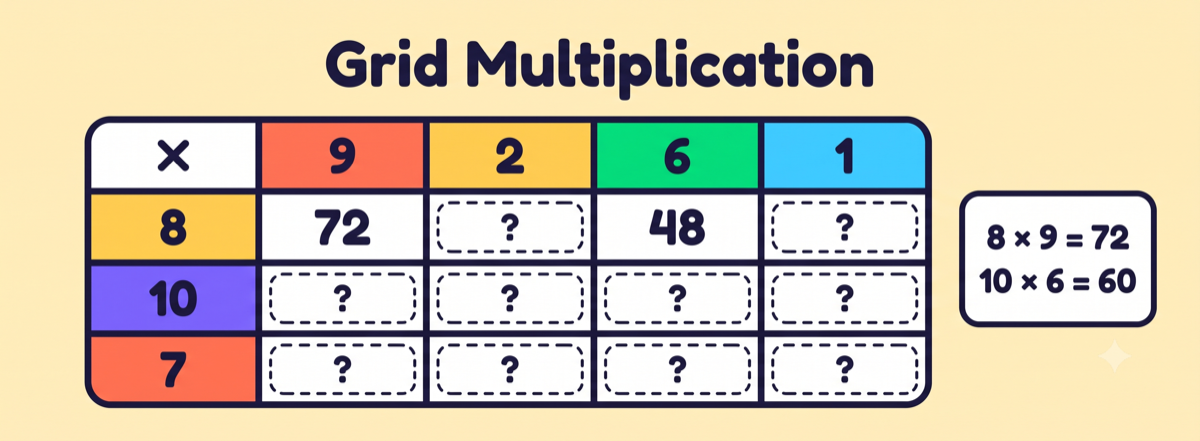
Skill: Multiplication facts and working backward in a fill-in puzzle. You'll need: a partly filled multiplication grid worksheet with row and column headers given.
How to play: Hand out a 4x4 grid with row and column numbers shown and some cells filled. Students multiply the matching headers to fill the blanks, then compare answers in pairs and discuss any differences: "I got 54, how did you get 56?"
Three levels:
- Just starting: Provide a times-table reference and use smaller numbers (1 to 5).
- On level: A 4x4 grid with numbers up to 10 and no reference table.
- Ready for more: Remove the headers so students work backward from products to find the missing factors.
Quick check: Ask "What's 7 x 6?" quickly as they work. Instant recall shows fluency; counting up in sevens shows more practice is needed. Time: 10 to 15 minutes.
6. Odd One Out: Spot What Doesn't Belong
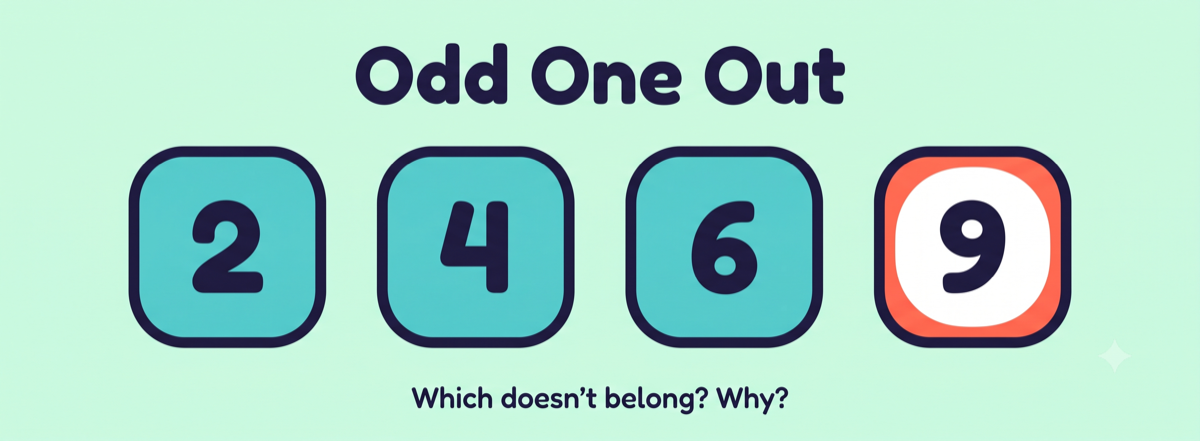
Skill: Number sense and reasoning by spotting the odd item in a set and saying why. You'll need: sets of four numbers on cards or a screen.
How to play: Show a set like {2, 4, 6, 9} and ask "Which is the odd one out, and why?" There may be more than one valid answer, but students must justify their choice. Then challenge them to create their own set for a partner.
Three levels:
- Just starting: Obvious sets (three even numbers and one odd), with a hint about what rule to look for.
- On level: More ambiguous sets where several answers are possible.
- Ready for more: Sets involving place value, fractions, or geometric properties.
Quick check: The best answers are justified, not instinctive. "9 is odd because the others are even" shows understanding; "9 just looks different" does not. Time: 5 to 10 minutes.
7. Fizz Buzz Chant: Multiples and Times Tables
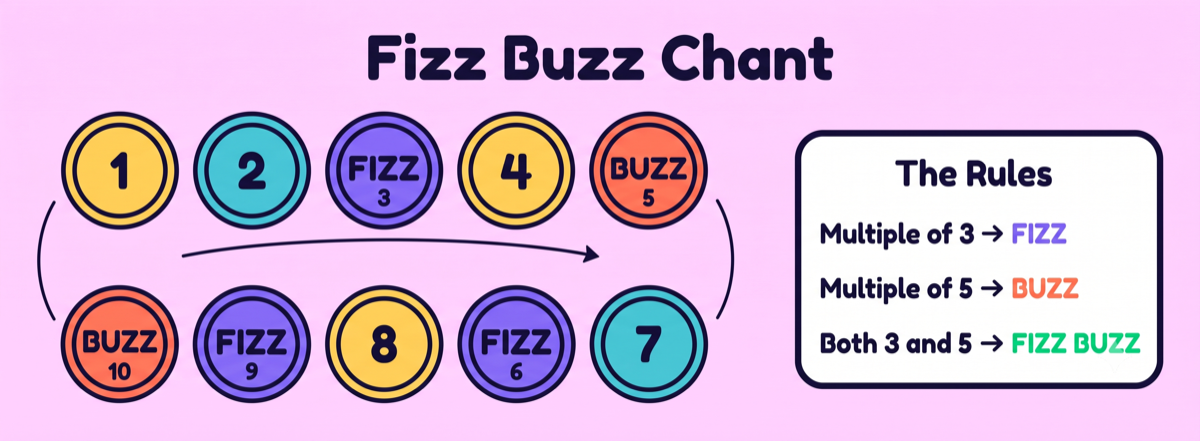
Skill: Multiplication tables and number patterns in a fast, call-and-response game. You'll need: nothing but a group in a circle.
How to play: Agree on the rules, for example "Fizz" for multiples of 3 and "Buzz" for multiples of 5. Count around the circle: 1, 2, Fizz, 4, Buzz, Fizz, 7, 8, Fizz, Buzz, and so on. A wrong answer restarts the count from 1.
Three levels:
- Just starting: One rule only ("Fizz" for every 2nd number).
- On level: Classic Fizz (3s) and Buzz (5s).
- Ready for more: Add a third word for a third multiple, like "Zap" for multiples of 7.
Quick check: "What happens at 15, and why?" Students who understand will explain that 15 is a multiple of both 3 and 5, so they say "Fizz Buzz." Time: 5 minutes, ideal as a transition.
8. Place Value Puzzles: Hundreds, Tens, and Ones
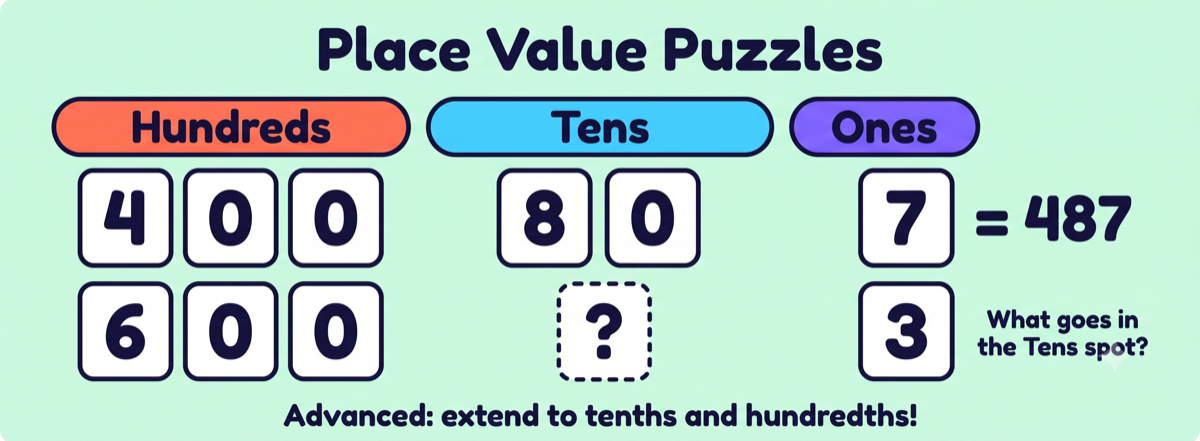
Skill: Understanding units, tens, hundreds (and decimals) by building and taking apart numbers. You'll need: printed place value charts and colored digit cards (400, 80, 7, and so on).
How to play: Show a partly completed chart and have students read the number (600 + 50 + 3 = 653). Then give a target: "Build 487," and they place "400, 80, 7" in the correct columns. Extend to tenths for students who are ready.
Three levels:
- Just starting: Two-digit numbers (tens and ones only), with base-10 blocks.
- On level: Three-digit numbers, written in both expanded and standard form.
- Ready for more: Include tenths and hundredths, and practice rounding to the nearest ten or tenth.
Quick check: "What is 5 tens and 8 ones?" Quick verbal questions reveal whether students understand the value of each position. Time: 10 to 15 minutes.
All 14 Elementary Math Activities at a Glance
Use this table to pick an activity by skill, prep time, materials, and age. The no-prep ones are great for a quick warm-up or a spare five minutes. You can make any activity easier or harder in seconds by changing the numbers, objects, or rules.
| Activity | Skills Targeted | Prep Time | Materials | Age Range |
|---|---|---|---|---|
| Sorting Objects | Sorting, counting, more/less | ~5-10 min | Small toys, bowls | K-1 |
| Simon Says (Math) | Counting by movement, spatial words | None | Open space | K-1 |
| Garbage Card Game | Number order 1-10, counting | ~5 min | Deck of cards | K-1 |
| Pattern Block Pictures | Shape names, shape sense | ~5 min | Pattern blocks, templates | K-1 |
| Outdoor Number Hop | Number order, movement | ~10 min | Chalk or tape | K-1 |
| Crayon Counting Cards | Number-to-amount, adding | ~5 min | Printables, crayons | K-1 |
| Shape Counting Maze | Counting, shape recognition | ~5 min | Printed maze | Grades 2-4 |
| What's the Question? | Quick math facts, making problems | None | Whiteboards/paper | Grades 2-4 |
| Estimation Challenge | Estimation, grouping by tens | ~5 min | Classroom objects | Grades 2-5 |
| Math Bingo | Number facts, listening | ~10 min | Paper grids, markers | Grades 2-5 |
| Grid Multiplication | Multiplication, working backward | ~5 min | Grid worksheet | Grades 2-4 |
| Odd One Out | Number sense, reasoning | ~5 min | Number cards | Grades 2-5 |
| Fizz Buzz Chant | Times tables, patterns | None | Standing circle | Grades 2-4 |
| Place Value Puzzles | Units, tens, hundreds, decimals | ~5 min | Place value cards | Grades 2-5 |
Elementary Math Activities for Home
The best elementary math activities for home use things you already have and take only a few minutes. Turn everyday moments into small games: count, sort, estimate, and reason. Keep each one short and playful, and your child gets math practice without it feeling like a lesson.
This is exactly what Cuemath tutors tell parents to do at home. Here is a simple way to use these activities:
- Count and compare real things. Sort laundry or LEGO by color, then ask which pile has more or less (Sorting Objects).
- Turn answers into questions. Say "the answer is 12" and have your child make up a word problem for it (What's the Question).
- Estimate, then count. Guess how many spoons are in the drawer, then count by tens to check (Estimation Challenge).
- Chant times tables. Play Fizz Buzz in the car to practice multiples of 3 and 5 (Fizz Buzz Chant).
- Build numbers. Use scrap paper cards to make hundreds, tens, and ones for any number your child sees (Place Value Puzzles).
You don't need worksheets. The three levels in each activity let you make any game easier or harder right away. That is why these simple games work so well at home.
Elementary Math Activities for Summer
Elementary math activities for summer keep skills sharp so kids don't slip before school starts. Kids can lose about two months of math skills over the break, but a few short, fun games each week are enough to stop it.
Over the summer, use these activities in a light, no-pressure way:
- Take math outside. Chalk a scattered number grid for Outdoor Number Hop, or estimate how many steps to the mailbox.
- Play games in the car. Fizz Buzz and Odd One Out need nothing at all.
- Count real things. Shells, berries, or cards on a road trip all work for estimating and grouping.
- Add daily math games. Short, playful practice on an app keeps facts and times tables fresh between activities.
In the last week or two of summer, do one short activity a day as a gentle warm-up so the first day back feels familiar.
Math Games and Tutoring Cuemath Tutors Recommend
When these activities click and your child wants more, Cuemath tutors point parents to two next steps. Short daily math games, and 1:1 tutoring when your child is ready for a set routine. Both use the same hands-on approach as the activities above.
Daily math games for 10 minutes of playful practice
Cuemath’s math games are the app version of the counting, estimation, and times-table games above. They are quick, they adjust to your child, and they grow a little each day.
1:1 tutoring by grade, whenever your child is ready
A Cuemath tutor teaches elementary math one-on-one, using these same hands-on games and adjusting each one to your child’s grade and pace.
Keep the momentum going as your child moves up through elementary school. These guides pick up where these activities leave off:
Suggested Reading
Give Your Elementary Schooler a Strong Start This Year
See how a Cuemath tutor turns counting, multiplication, and reasoning into a class your child looks forward to. Book a free 1:1 class for grades K to 5 today.
Book a Free ClassFree 1:1 class · Grades K to 5 · No credit card needed
Frequently Asked Questions
What are the best back-to-school math activities for elementary students?
The best back-to-school math activities for elementary students are hands-on games that teach one skill at a time, from counting and sorting in the early grades to multiplication, estimation, and place value later. The 14 activities in this guide each use everyday things, take 5 to 20 minutes, and come with three levels. Cuemath tutors who teach elementary math every day recommend games just like these.
What are good back-to-school math activities for kids?
Good back-to-school math activities for kids are short, playful, and hands-on, so learning feels like a game, not review. Sorting piles, math bingo, estimation jars, and a Fizz Buzz chant all work well and need almost no prep. You can make each one easier or harder by changing the numbers or rules, so the same game fits a range of ages.
What elementary math activities work for summer?
Elementary math activities for summer should be light and playful to stop the summer slide. Outdoor number games, car-ride Fizz Buzz, estimating with real objects, and short daily math games all keep skills sharp without feeling like schoolwork. Aim for a few 10-minute games a week instead of daily worksheets.
How can I teach elementary math at home using simple activities?
You can teach elementary math at home using simple activities by turning everyday moments into games: sort laundry by color, estimate then count objects, chant times tables in the car, and build numbers with scrap-paper cards. Keep each one short and let your child explain their thinking. Cuemath's tutors use these same habits in their 1:1 elementary classes.
What math activities help kids learn multiplication and times tables?
Math activities that help kids learn multiplication and times tables include the Fizz Buzz chant, math bingo with multiplication clues, and the grid multiplication puzzle in this guide. These turn boring fact practice into a game, which builds speed faster than flashcards alone. For a child who is stuck, a Cuemath tutor can find which facts need work and practice them one-on-one.
How long should elementary math activities take?
Elementary math activities should take about 5 to 20 minutes, depending on the game and age. Quick games like Fizz Buzz run about 5 minutes, while bigger ones like the shape counting maze or place value puzzles can run 15 to 20. Keep them short enough to stop while your child is still into it.
When should I consider a math tutor for my elementary schooler?
Think about a math tutor for your elementary schooler if they avoid math, fall behind on grade-level facts, or lose confidence even with practice at home. A Cuemath tutor works 1:1 for grades K to 5 using the same playful, hands-on games as this guide, so help feels like help, not pressure. The first class is free, and you don't need a credit card.
Sources
- Common Core State Standards, Mathematics (K to 5) — the counting, geometry, multiplication, and place-value skills each activity targets.
- Third Space Learning — back-to-school math engagement and hands-on activity design.
- NRICH, University of Cambridge — research-backed mathematical reasoning tasks.
- DREME, Stanford Graduate School of Education — research on early math learning and number sense.
- National Council of Teachers of Mathematics (NCTM) — standards and guidance for elementary math instruction.

I grew up a science kid. Math was not my best subject. Class moved fast, I was too shy to ask for help, and I somehow ended up more curious about how people learn than about the subjects themselves.
That's what pulled me into education, not to teach, but to understand how schools and tutoring programs actually work and what young learners genuinely need from them.
My love for writing did the rest. Over the last five years I've written about edtech, student life, and how kids learn math. This guide is recommended by Cuemath's expert tutors.
I work at Cuemath now, so factor that in. I research by going where parents actually talk: forums, reviews, and direct conversations with families. I'm writing for the parent trying to make math feel less scary, one game at a time.