
AP Calculus AB vs BC: Which Should You Take and How to Prepare?
Choosing between AP Calculus AB and BC isn’t about which course is harder, it is about finding the right fit for you. After researching college policies and student outcomes, this blog is my take on choosing between AB and BC, based on intended major, and college credit rules.

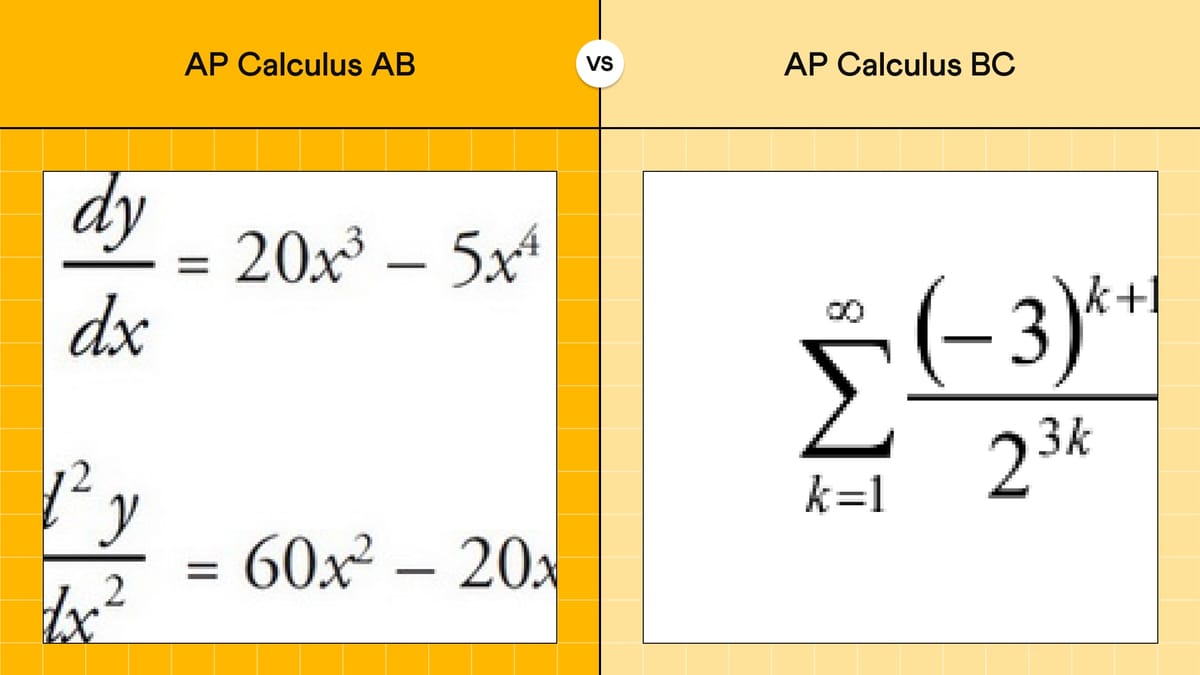
Let's be real – choosing between AP Calculus AB or AP Calculus BC feels like it could define your entire junior or senior year. It’s the classic high school dilemma.
Here’s what I’ve come to realize: we’re all so focused on which class is harder that we’re asking the wrong question. The truth is, the best choice isn't a choice at all—it's a fit.
After talking to high schoolers and guidance counselors, I've realized you just need to honestly answer three questions to get this right:
- Your Future Goals: What's your intended major, and how competitive are your target colleges?
- The Credit Game: What do those colleges actually give you credit for?
- Your Math Skills: How quickly do you learn math, not just how good you are at it?
Key Takeaways
- Choose Your Fit: Your choice between AP Calculus AB vs. BC should depend on your major and your target colleges.
- Core Difference: The courses are not sequential. AP Calculus AB covers one semester of college calculus (Calc I), while AP Calculus BC covers two semesters (Calc I + II) in a single year.
- Decision by Major: AP Calculus BC is recommended for top-tier STEM and CS majors. AP Calculus AB is the ideal choice for Pre-Med, Life Sciences, and Humanities.
- Check College Credit: AP credit policies vary by university and even by program (e.g., Engineering vs. Arts & Sciences). You will need to check each school's policy directly.
Do You Take AP Calculus AB Before BC? One Course or Two Different Paths?
The single biggest misunderstanding I found is that AB and BC are sequential courses—that you take AB one year and BC the next.
This is incorrect. The College Board did not design them to be taken back-to-back.
Think of it this way:
- AP Calculus AB is a full-year course that covers the first semester of college calculus (Calculus I).
- AP Calculus BC is a full-year course that covers both the first and second semesters of college calculus (Calculus I and II)
This means AP Calculus BC includes 100% of the AB curriculum, plus new, more advanced topics. A student is meant to take either AB or BC.
Source: CollegeBoard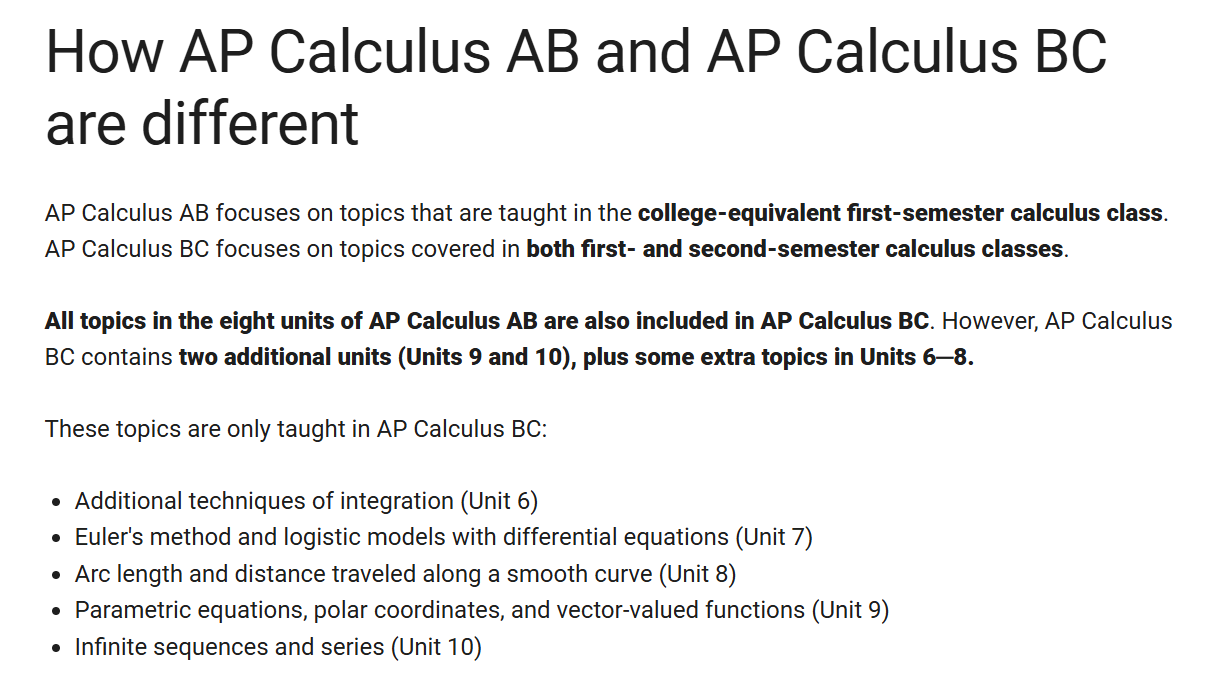
Are AP Calculus BC Scores Higher? Does That Mean It's Easier?
This is the first thing I researched, because the data looks quite strange. When you look at the 2024 score distributions, you will see something that confuses a lot of students and parents:
| Score | AP Calculus AB | AP Calculus BC |
|---|---|---|
| 5 | 21.4% | 47.7% |
| 4 | 27.8% | 21.1% |
| 3 | 15.3% | 12.1% |
| % 3+ | 64.4% | 80.9% |
What Are the Actual Prerequisites for AP Calculus AB and BC?
Here’s where I had to do some research, because the official answer is misleading.
- Officially, the College Board lists the same requirements for both AP Calculus AB and BC, and they are quite general.
- They recommend that you've successfully finished courses in algebra, geometry, trigonometry, analytic geometry, and elementary functions.
- But for AP Calculus BC, students are specifically expected to understand sequences, series, and polar equations. These are topics taught in an advanced or Honors Pre-Calculus class.
- Some very competitive high schools might raise the bar even higher, demanding a 95% in Honors Pre-Calculus just to be considered for the BC class.
This shows that schools see AP Calculus BC as a class meant only for students who have already proven they are very strong in math.
Which AP Calculus is Right for Your Major?
This is the most important part of my research. Your choice sends a signal to colleges. Here’s how to align your choice with your academic and career goals.
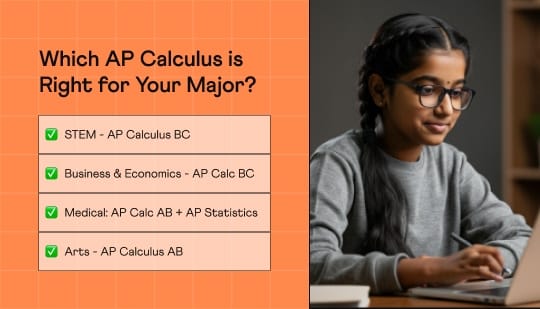
🧪 STEM (Engineering, Computer Science, Physics)
For top-tier universities (e.g., MIT, Carnegie Mellon, Caltech, Berkeley-EECS), taking AP Calculus BC (if offered) is not a bonus; it is an expectation. For a competitive CS or engineering program, choosing AP Calculus AB when BC is available can be viewed as not rigorous.
These majors will all require Calculus I and II, and often Calculus III (Multivariable) and Linear Algebra.
💲Business and Economics
I found that many business majors (e.g., Management, Marketing) will only require a Business Calculus or brief Calculus course in college, which is often less rigorous than Calculus I. AP Calculus AB is more than sufficient to earn credit for this and is a good choice.
Quantitative Finance/Economics degrees (especially for students considering a Ph.D.) are extremely math-heavy. For these programs, AP Calculus BC is almost the expectation. Advanced economics uses concepts from Calculus I, II, and multivariable calculus.
🏥 Life Sciences and Pre-Medical
Pre-med and life science majors (Biology, Neuroscience, etc.) typically require one semester of calculus (Calculus I), for which AP Calculus AB is a perfect fit.
AP Statistics is arguably as important, or more important, than the Calculus II topics in AP Calculus BC. Medical research and biology are heavily dependent on data analysis.
🎨 Literature and Arts
For students majoring in English, History, Political Science, or other humanities, the goal is twofold: satisfy a core university math requirement and demonstrate quantitative rigor on a college application.
AP Calculus AB achieves both of these goals perfectly. It is a rigorous, respected course, but its moderate pace makes it a manageable part of a schedule that may be heavily loaded with reading- and writing-intensive APs (e.g., AP English Literature, AP U.S. History).
What Top Colleges Recommend - AP Calculus AB or BC?
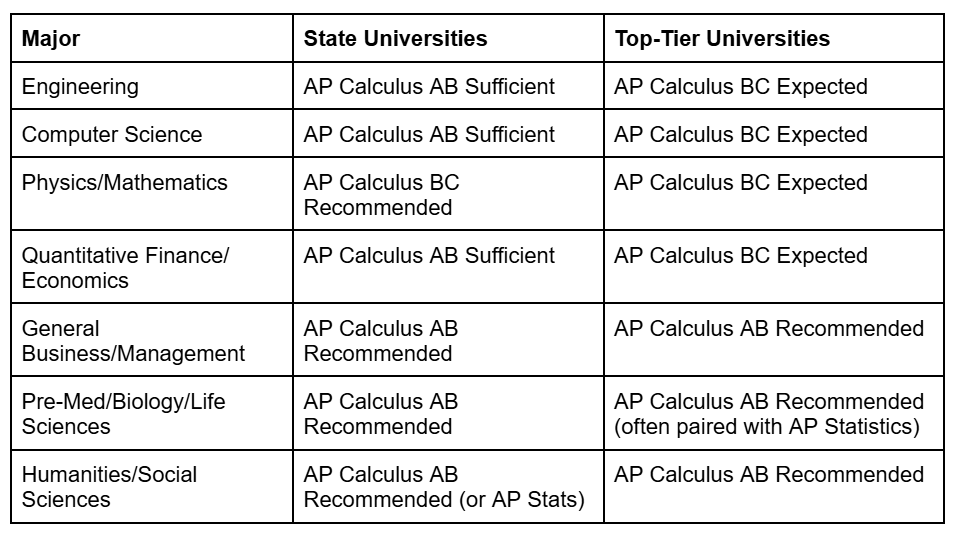
I put together this table based on all the college sites and forums I reviewed. It simplifies the recommendations at a glance.
AP Calculus Credit: Why a 5 at MIT is Different Than at UC?
This is the #1 mistake I see students make. They assume getting a good score automatically gets them credit.
The reality? Every single school is different. And the policy often changes by program (e.g., Engineering vs. Arts & Sciences).
The General Rule:
- Pass AB (Score 3–5) -> Get credit for one semester (Calculus I).
- Pass BC (Score 4–5) -> Get credit for two semesters (Calculus I & II).
The Reality: Every single school is different. And the policy often changes by program (e.g., Engineering vs. Arts & Sciences).
I compiled these examples just to show you how wild the differences are:
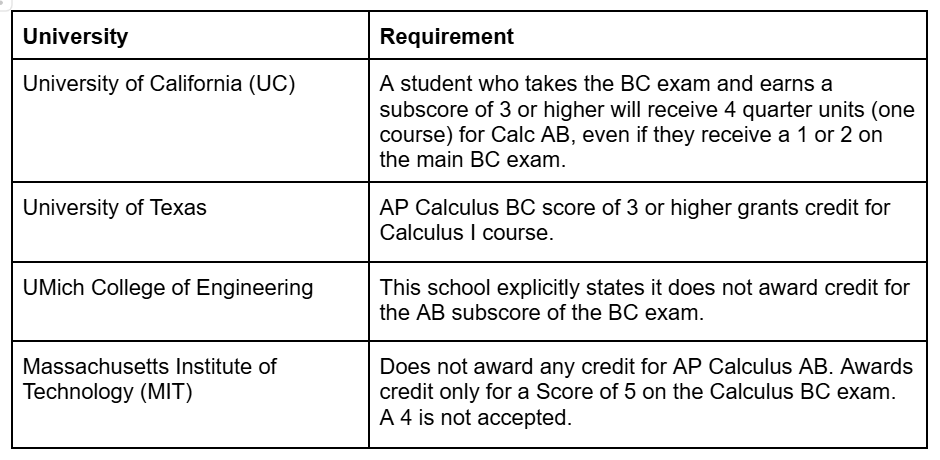
(Sources: UC Admissions, UT Texas, UMich Admissions, MIT Admissions)
The Bottom Line: Do not guess. You must go to the website of every college you are interested in, find their AP Credit Policy, and check the specific rules for your intended major.
How to Prepare for AP Calculus AB and BC?
To prepare for either exam, you will need a regular study schedule and the right resources. Start by taking a ‘Calculus Readiness Test’ to see where you stand with essential skills like algebra, functions, and trigonometry; even colleges like Duke use these to ensure students have mastered precalculus.
Once you are ready, the best official practice comes from the College Board's website, which has years of old FRQs with scoring guides.
Need a Structured AP Calculus Plan? How Cuemath Can Help!
An AP Calculus Score of 5 Can Be Worth $3,000+ in College Credit. Don't leave it to chance with pre-recorded videos or generic group classes.
Cuemath delivers a complete system for mastering AP Calculus AB or BC that goes far beyond self-study. You get 1:1, personalized math classes from a certified tutor, with a plan built around your specific speed and goals.
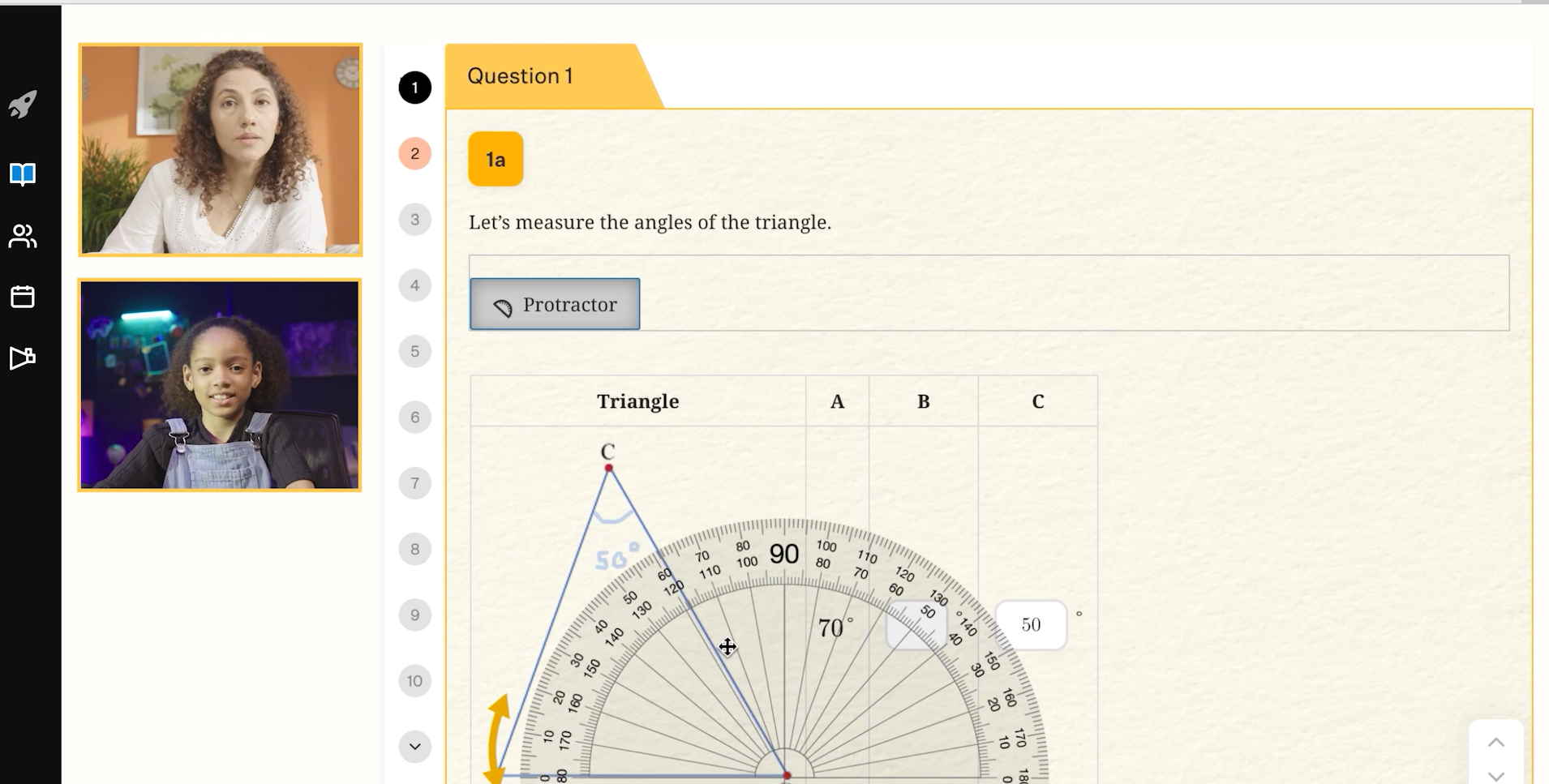
It all happens on their fully interactive LEAP platform, where you and your tutor solve challenging problems together in real-time on a shared Smart Whiteboard.
Where Hard Work Turns Into Real Results
Give your child the same structured guidance that helped thousands of students succeed. Try a FREE live Cuemath class today.
Book a Free ClassFor Students in Grades K to 12 Worldwide
Frequently Asked Questions (FAQs)
Ques: Do students need to do AP Calculus AB before AP Calculus BC?
Ans: AP Calculus AB and AP Calculus BC are not sequential courses (to be taken after another). Students choose either AP Calculus AB or AP Calculus BC based on their intended major in college and future prospects.
Ques: Is AP Calculus BC better for college admissions than AB?
Ans: The better choice depends on your intended field. For STEM majors (engineering, CS, physics), AP Calculus BC is a better course. STEM majors require good knowledge of Calculus I-II. For business, life sciences, pre-medical, and humanities, AP Calculus AB is an appropriate course. It meets college requirements while still reflecting strong academic rigor.
Ques: Do colleges give the same credit for AP Calculus AB and BC?
Ans: No, colleges have different credit policies for AP Calculus AB and BC. Some universities (like UC and UT Austin) give credit only if the AP Calculus BC score is 3+, or sometimes they consider the AB subscore. UMich Engineering ignores the AB subscore entirely. MIT awards credit only for a 5 on AP Calculus BC, and gives no credit for AB. It is important to check each college’s AP credit policies.

About the Author
Nikita Joshi
Math Educator | Writer @ Cuemath
Math educator & writer by day, storyteller by night.
View My LinkedIn
Read more

Cuemath Reviews: Student & Parent Reviews [Updated 2026]
In this blog, I share various Cuemath reviews from parents and students on what they love the most about Cuemath (caring 1:1 tutors, deep understanding, and growing math confidence), along with the common questions families ask before starting.

How Much Does Math Tutoring Cost for High School in 2026?
Parents and high school students today care less about the cheapest math tutoring option and more about real results. Here, I assess the tutoring costs, personalization, and why 1:1 online math tutoring often gets the best value.

How Often Should High Schoolers Do Tutoring? Weekly Schedules That Work
Just as the tutor–student relationship is key to better math learning, the schedule matters just as much. Based on research, student feedback, and cognitive science, I analyze why a 3-day-a-week tutoring schedule helps high schoolers rebuild confidence in math.
Math Placement Test Prep Strategies + Important Topics
Math placement tests are used by over 90% of educational institutions to connect the student with the math class that actually fits their caliber.