20 Cool Math Facts That Will Change the Way You See Numbers
Explore 20 cool math facts that make learning numbers exciting! From mind-bending patterns to surprising number secrets, these facts go beyond memorisation and help build deeper mathematical thinking.

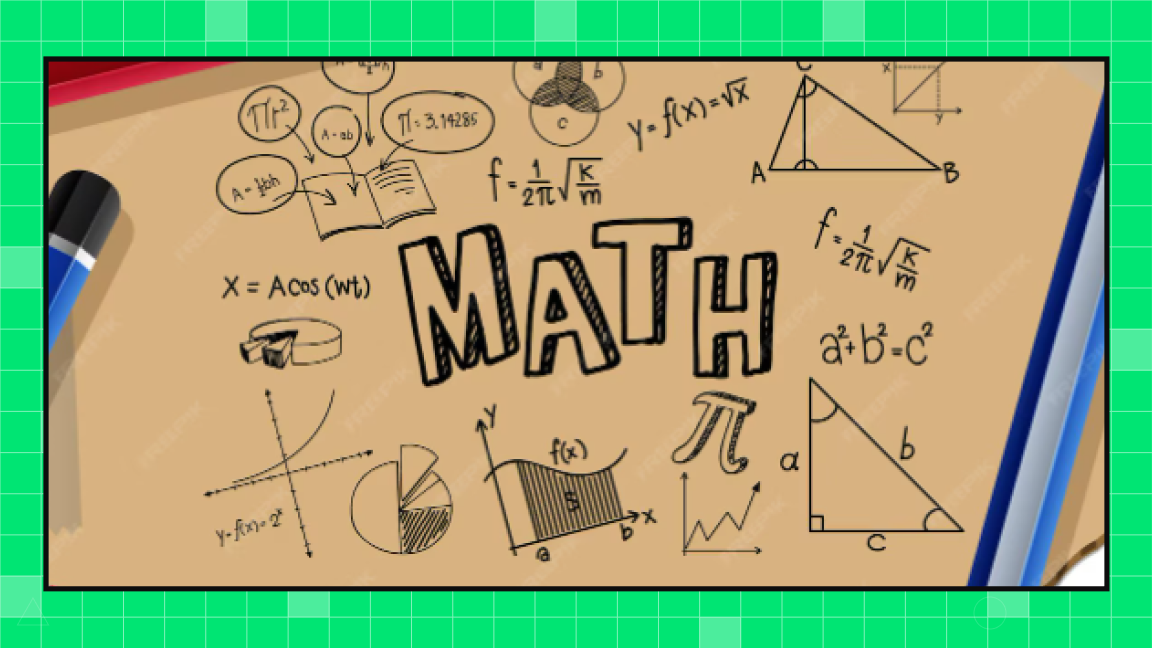
Some math facts feel impossible the first time you hear them. A group of 23 strangers has a better-than-even chance of sharing a birthday. The number 0.999… is exactly equal to 1, not approximately, exactly. A shuffled deck of cards is almost certainly arranged in a sequence that has never existed before in history.
These aren't tricks. They're genuine results — and they reveal something important: math isn't about speed, it's about structure. Once you start seeing that structure (patterns), you notice it everywhere.
Here are 20 cool math facts (plus 15 bonus ones below) that make numbers genuinely surprising.
Key Takeaways — TL;DR
The 20 cool math facts at a glance:
Join Cuemath and see how numbers come alive with exciting patterns and challenges!
Here are 20 Math Facts That Will Change the Way You See Numbers
1. The Number That Isn’t Almost 1
0.999… looks like it should be slightly less than 1.
But:
1 ÷ 3 = 0.333…
Multiply both sides by 3
1 = 0.999…
Not close. Not rounded. Exactly equal.
Math quietly breaks intuition.
2. The Room of 23 People- Birthday Paradox
You walk into a classroom with 23 students.
What are the chances that two people share a birthday?
Most people guess 10%. Maybe 20%.
The real answer?
Over 50%.
It’s called the Birthday Paradox — and it shows how probability often behaves in ways that surprise us.
3. Six People Guarantee a Pattern
Here’s a wild one:
In any group of 6 people, there will always be either:
3 mutual friends or 3 mutual strangers. No matter who they are.
This idea comes from Ramsey Theory — and it shows that structure can even appear within chaos.
4. Infinity Isn’t Just One Thing
There are infinitely many whole numbers.
1, 2, 3, 4, 5…
But between 0 and 1 alone, there are also infinitely many decimal numbers.
And here’s the twist: There are actually more decimal numbers than whole numbers.
Infinity has different sizes.
That realization changed mathematics forever.
5. The Prime Numbers Never End
2, 3, 5, 7, 11…
Primes are the building blocks of numbers.
Over 2,000 years ago, Euclid proved there are infinitely many of them.
They never stop. They just get harder to find.
6. Logic Beats Calculation
Mastering Olympiad problems aren’t about doing more calculations — they’re about thinking smarter.
Take parity:
Odd + Odd = Even
Odd × Odd = Odd
That tiny observation can instantly eliminate half the answer choices.
Smart beats fast.
7. A Square Number Leaves a Clue
Here’s a powerful elimination trick:
A perfect square can only end in
0, 1, 4, 5, 6, or 9.
If a number ends in 2, 3, 7, or 8 —
It cannot be a perfect square.
That’s not memorization. That’s pattern awareness.
8. The Triangle That Breaks 180°
You learned:
The three interior angles of any Euclidean triangle always sum to exactly 180 degrees.
True… on flat paper.
But draw a triangle on a sphere (like Earth), and the angles can add up to more than 180°.
Geometry changes when space curves.
Math adapts.
9. The Circle Always Wins
Among all shapes with the same perimeter,
The circle encloses the maximum area.
Nature figured that out long before we did.
Soap bubbles. Planets. Ripples.
Efficiency chooses circles.
10. The Handshake Explosion
Imagine 100 people in a room, each shaking hands once with everyone else.
How many handshakes?
4,950.
Here’s the structure behind it:
- Person 1 shakes hands with 99 people
- Person 2 shakes hands with 98 new people
- Person 3 with 97
- And so on…
Each handshake involves two people, so we count:
Math Fact:
When everyone connects with everyone once, the total is
Not linear. But, Quadratic.
It grows much faster than intuition expects.
Quadratic growth can be hidden in simple social situations.
11. Zero (0) Divides Nothing — But Controls Everything
Zero changed civilization.
Without zero:
- No place value
- No algebra
- No computers
The most powerful number is the one that represents nothing.
12. You Can’t Trisect an Angle
For 2,000 years, mathematicians tried to divide any angle into three equal parts using just a compass and a ruler.
It's Not hard. It's Impossible.
Math sometimes proves limits, not just solutions.
13. Fibonacci Hides in Flowers
Look at a sunflower. Count the spirals.
You’ll often find Fibonacci numbers:
1, 1, 2, 3, 5, 8, 13…
Nature grows in patterns.
14. The Number 'e' Runs Growth
Compound interest.
Population growth.
Continuous change.
They all use a strange number:
e ≈ 2.718…
It appears whenever growth is continuous — in compound interest, population models, and calculus.
This constant, known as Euler's number, connects finance, biology, and physics.
Growth has a signature.
15. Random Numbers Aren’t That Random
Pick two random whole numbers.
What’s the chance they have no common factor?
About 60%.
The exact answer is 6/π².
Yes — π shows up in number theory.
Math connects unexpectedly.
16. Powers Repeat
Look at the last digits of powers of 7:
7, 9, 3, 1
7, 9, 3, 1…
They repeat in cycles.
Patterns are everywhere.
17. Big Problems Hide Small Structure
The hardest competition problems often collapse after spotting one small idea.
For example:
What is 1 + 2 + 3 + … + 100 ?
Looks long and tiring.
But notice the structure: Pair the first and last numbers:
1 + 100 = 101
2 + 99 = 101
3 + 98 = 101
Each pair makes 101.
There are 50 pairs.
So the total is: 50 × 101 = 5,050
The problem didn’t need 99 additions. It needed one pattern.
That’s math fluency. Not speed, but structure.
Math Fact fluency isn’t about memorizing formulas.
It’s about seeing structure.
18. A Deck That Defies Intuition
Shuffle a standard deck of 52 cards.
The exact order you’re holding has almost certainly never existed before in human history.
Why?
There are 52! (52 factorial) possible arrangements.
That number is about
8 × 10⁶⁷.
That’s more than the number of atoms on Earth.
Ordinary objects.
Extraordinary scale.
19. You Can Prove √2 Is Irrational
Assume √2 is a fraction.
After a few logical steps, you’re forced to conclude that a number is both even and odd at the same time.
Impossible. So √2 cannot be written as a fraction.
One of the first great shocks in mathematics:
Not all numbers fit neatly into ratios.
Logic can prove what intuition never suspects.
20. Every Map Needs Fewer Colors Than You Think
No matter how complicated a map is,
you only need four colors to color it
so that no two neighboring regions share the same color.
Not five. Not six. Four.
It took computers to finally prove it in 1976.
Even something as messy as geography obeys hidden limits.
15 More Cool Math Facts (With Clear Explanations)
Mathematics is not just about numbers — it’s about surprising patterns, hidden logic, and beautiful structures. Here are 15 more cool math facts explained clearly and simply.
Fact 21 — The Monty Hall Problem
This famous probability puzzle comes from a game show. You pick one of three doors. Behind one is a car; behind the other two are goats.
The host opens one of the remaining doors and shows a goat. If you switch your choice, your winning chance increases from 1/3 to 2/3. Even though it feels like 50–50, switching actually doubles your probability of winning.
Fact 22 — The Magic of 1089
Choose any 3-digit number where the first digit is larger than the last. Reverse the number and subtract the smaller from the larger.
Reverse the result and add them together. No matter which number you start with (following the rule), the answer is always 1089. This works because of how place values interact in subtraction.
Fact 23 — The Hardy–Ramanujan Number (1729)
1729 is special because it can be written as the sum of two cubes in two different ways:
1729 = 1³ + 12³ = 9³ + 10³.
This makes it the smallest number with this property, which is why mathematicians find it fascinating.
Fact 24 — Benford’s Law
In many real-world data sets (like stock prices, river lengths, or populations), numbers don’t start evenly with digits 1–9.
About 30% of the time, the first digit is 1. This surprising pattern is called Benford’s Law and is even used in fraud detection because fake data often doesn’t follow this rule.
Fact 25 — The Impossible Chessboard
If you remove two same-colored corners from a chessboard, you cannot cover the board completely using dominoes.
Each domino covers one black and one white square. Removing two corners of the same color makes the board unbalanced, so perfect tiling becomes mathematically impossible.
Fact 26 — π Appears in Probability
In Buffon’s Needle experiment, you drop a needle on lined paper and calculate the probability it crosses a line. Surprisingly, the formula involves π.
This shows that π is not just about circles — it appears naturally in probability and geometry.
Fact 27 — Multiples of 9 Self-Check
If a number is divisible by 9, the sum of its digits will also be divisible by 9.
This works because of how place values behave in base 10 arithmetic, making it a quick mental math trick.
Fact 28 — The Infinite Hotel (Hilbert’s Hotel)
Imagine a hotel with infinitely many rooms, all occupied. A new guest arrives.
By moving each guest from room n to room n+1, room 1 becomes free. This thought experiment shows how infinity behaves very differently from ordinary numbers.
Fact 29 — A Googol
A googol equals 10¹⁰⁰, which is a 1 followed by 100 zeros.
It is far larger than the estimated number of atoms in the observable universe, showing how quickly exponential numbers grow.
Fact 30 — The Seven Bridges Problem
In the 1700s, people wondered whether it was possible to cross each bridge in Königsberg exactly once.
Leonhard Euler proved it was impossible, creating the foundation of graph theory — a major area of modern mathematics.
Fact 31 — Squaring Numbers Ending in 5
To square a number ending in 5 (like 35²), multiply the first digit(s) by the next number and add 25 at the end.
For example, 35² → 3 × 4 = 12, so the answer is 1225.
Fact 32 — Infinite Sum, Finite Result
The series 1/2 + 1/4 + 1/8 + 1/16 + … continues forever.
Yet, the total approaches exactly 1. This shows how infinitely many decreasing terms can still produce a finite result.
Fact 33 — Euler’s Identity
eiπ + 1 = 0 combines five fundamental constants: e, i, π, 1, and 0.
It connects algebra, geometry, and complex numbers in one elegant equation, often called the most beautiful formula in mathematics.
Fact 34 — Irrational Numbers Dominate
Between any two rational numbers, there are infinitely many irrational numbers.
In fact, irrational numbers are more numerous than rational numbers, even though rationals feel more “common.”
Fact 35 — The Collatz Conjecture
Take any positive number. If it’s even, divide by 2. If it’s odd, multiply by 3 and add 1.
No matter what number you start with, it always seems to eventually reach 1 — but no one has proven this for all numbers yet.
Conclusion: Math Facts Are More Than Memorizing Numbers
These math facts show how mathematics is full of surprising connections, clever patterns, and deep ideas. Whether you're a student or just curious, exploring math facts can completely change the way you see numbers.
Numbers aren’t about speed. They’re about seeing patterns where others see randomness.
That’s the idea behind MathFit at Cuemath. It’s not about racing through worksheets or memorizing steps. It’s about training the mind to notice structure, break complexity into clarity, and move from confusion to confidence. In a world where AI can calculate instantly, clear thinking becomes the real advantage — and that’s the edge MathFit is designed to build.
Build speed, confidence, and accuracy in math facts with Cuemath’s fun, interactive practice.
Turn Curiosity into Math Mastery!
 Neelima Kotamraju
 Pooja Purohit
Frequently Asked Questions on Cool Math Facts
❓ Why is 0.999… equal to 1?
0.999… seems slightly less than 1, but mathematically it is exactly equal. For example, 1 ÷ 3 = 0.333…, and multiplying both sides by 3 gives 1 = 0.999… It’s not an approximation—it’s an exact equality.
❓ What is the Fibonacci sequence in nature?
The Fibonacci sequence (0, 1, 1, 2, 3, 5, 8…) appears in flowers, pinecones, shells, and fruit seeds. Petals and seeds often follow Fibonacci numbers to maximize sunlight or packing efficiency.
❓ Can you prove √2 is irrational?
Yes! √2 cannot be expressed as a ratio of two integers. If you assume it can, you reach a contradiction where both numbers would have to be even, which is impossible. This classic proof shows √2 is irrational.
❓ How many colors are needed to color any map?
The Four Color Theorem proves that four colors are enough to color any map so that no two adjacent regions share the same color.
❓ Why is a triangle with sides 3, 4, 5 special?
It’s a right triangle because 3² + 4² = 5². Triangles with side lengths that satisfy the Pythagorean theorem are called Pythagorean triples.
❓ What’s special about the number 1729?
1729 is the Hardy–Ramanujan number — the smallest number expressible as the sum of two cubes in two different ways: 1729 = 1³ + 12³ = 9³ + 10³.
❓ Why is zero unique in math?
Zero is the only number that is neither positive nor negative, and it’s the only number that cannot be represented in Roman numerals.
❓ What is the magic of 1089?
Take any 3-digit number where the first and last digits differ by at least 2. Reverse it, subtract the smaller from the larger, then reverse the result and add. The answer is always 1089.
❓ Why do some patterns appear in multiplication tables?
Patterns in multiplication (like 9×1=9, 9×2=18, 9×3=27…) exist because of the properties of base-10 numbers and can help students spot shortcuts.
❓ Are prime numbers infinite?
Yes! There’s no largest prime. Euclid proved that no matter how many primes you list, there’s always another one.

About the Author
Neelima Kotamaju
Educator
With 10+ years in EdTech, I design learning experiences rooted in pedagogy, classroom insights, and child psychology, ensuring my work is meaningful and engaging.
This blog has been reviewed by Cuemath’s team of expert tutors & curriculum specialists, trained in US Common Core State Standards.
View My LinkedIn